


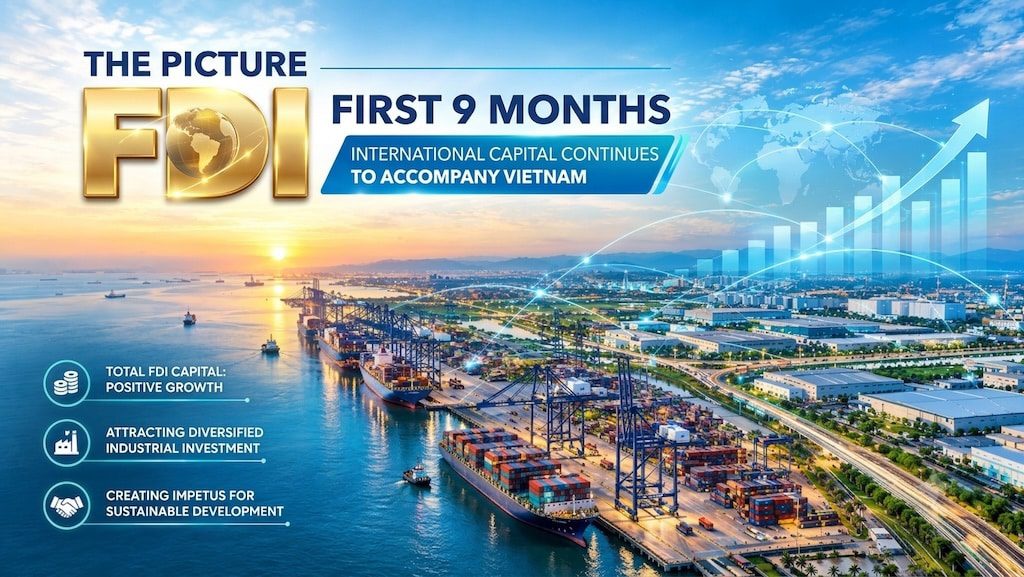
Vietnam FDI reached USD 50.36 billion in registered capital in the first 9 months of 2026, an increase of 76.4% year-on-year. Processing and manufacturing continue to be the largest destination; transportation and warehousing have emerged among new projects. However, registered capital and realized capital are two different indicators and need to be read separately to accurately reflect investment attractiveness and absorption capacity.
Vietnam FDI – What does the USD 50.36 billion consist of?
To correctly understand the scale of FDI into Vietnam, one must look at the components rather than just using a single total figure. Newly granted capital reflects newly licensed projects; adjusted capital represents the added portion of existing projects; while capital contributions and share purchases include transactions involving the acquisition of shares in domestic enterprises.
| Component | Value | Compared to Same Period | How to Read |
|---|---|---|---|
| Newly granted registration | USD 29.24 billion | 2.4 times | 3,108 projects; number of projects up 6.2% |
| Capital adjustment increases | USD 14.15 billion | +25.1% | 948 turns of existing projects increasing capital |
| Capital contribution and share purchase | USD 6.97 billion | +44.0% | 2,335 transaction turns |
| Total Registration | USD 50.36 billion | +76.4% | Aggregation of the three components above |
Growth rates are calculated compared to the same period in 2025. Registered capital represents the committed scale according to investment dossiers, which does not equate to disbursed capital.
When analyzing FDI into Vietnam, all three registration components should be cross-referenced with project deployment paces rather than treating all announced capital as cash flow that has already entered production.
A notable point regarding FDI into Vietnam this year is that total newly registered capital grew much faster than the number of projects. This is a sign that the average capital scale of the new project group is larger, while also making the total figure more sensitive to a few large-capital projects. Therefore, growth figures should be read alongside deployment progress and disbursement levels.
Why did registered capital grow faster than the number of projects?
The gap between the growth rate of new capital and new projects is a noteworthy signal. Newly registered capital increased by 2.4 times year-on-year, while the number of projects grew by only 6.2%. It can be understood that the average capital scale of the new dossier group has increased significantly. This is an inference from two aggregate indicators rather than a separate statistic on the average value of each project. Nevertheless, it shows that a significant portion of the increase stems from larger investment plans, rather than merely an increase in small investors.
Capital adjustments adding USD 14.15 billion also offer another perspective. This is the supplemental capital registered by previously licensed projects, typically tied to decisions to expand, increase capacity, or add investment categories. The 25.1% increase indicates that existing investors continue to play an important role alongside new projects. When reading this figure, remember that this is still adjusted registered capital; projects can be deployed in multiple phases, and specific timelines will vary.
Capital contributions and share purchases reached USD 6.97 billion across 2,335 transaction turns. Such transactions can help investors access operating enterprises, markets, or distribution networks. However, an existing share purchase transaction does not necessarily generate a new factory or immediately add production capacity. Therefore, the scale of FDI capital into Vietnam should be read through all three “gates”: new projects, expansion of old projects, and investment via equity ownership.
This separation helps avoid two hasty conclusions. First, total capital growth does not mean the number of businesses or new factories grows at a comparable rate. Second, large registered capital does not automatically confirm that a project has completed land, construction, and operational procedures. A more reliable picture forms when registration figures are placed alongside realized capital, project progress, and connectivity with domestic enterprises.
Processing and Manufacturing Maintains the Lead
Within the newly registered capital group, processing and manufacturing received USD 13.38 billion, accounting for 45.8%. Transportation and warehousing ranked second with USD 5.14 billion, accounting for 17.6%; remaining industries reached USD 10.71 billion. This is a classification specific to newly granted capital, not the proportion of the entire USD 50.36 billion.
This structure shows that FDI into Vietnam still leans toward production capacity, while transportation and warehousing create an additional highlight within the new project group.
| Industry | Newly Granted Capital | Proportion in New Capital | Ranking |
|---|---|---|---|
| Processing and Manufacturing Industry | USD 13.38 billion | 45.8% | Leading |
| Transportation and Warehousing | USD 5.14 billion | 17.6% | Second |
| Other Industries | USD 10.71 billion | 36.6% | Various fields |
Proportions in the table are calculated based on the total USD 29.24 billion of newly registered capital.
Production is the Pillar
Processing and manufacturing not only leads in newly registered capital. When combining newly granted and adjusted capital, this sector reached USD 21.82 billion, equal to 50.3% of the total capital of both components.
Notable Logistics Infrastructure
Transportation and warehousing rank second in newly registered capital. This development makes port capacities, warehouses, transport connectivity, and logistics services a group of topics worth tracking.
Real Estate Maintains Large Scale
Calculated on new and adjusted capital, real estate business reached USD 6.94 billion, equivalent to 16%. This aggregated data excludes capital contribution and share purchase transactions.
Realized Capital Remains Concentrated in Factories
Processing and manufacturing accounted for USD 17.40 billion, equivalent to 82.6% of realized FDI capital. This is an indicator showing that manufacturing deployment remains the core of capital flows.
Overall, FDI into Vietnam is simultaneously demonstrating three demands: expanding factory capacities, increasing goods circulation capacity, and developing land funds to serve business operations.
Processing and Manufacturing: Capital Scale Must Go Hand in Hand with Project Quality
The leading position of processing and manufacturing aligns with Vietnam’s production role in regional supply networks. A factory project can drive demand for workshops, equipment, electricity, water, transportation, technical services, and labor recruitment. When FDI enterprises increase capacity, opportunities lie not only with land lessors or utility providers; domestic suppliers can also participate more deeply if they meet standards regarding quality, delivery, governance, and traceability.
However, total capital by sector does not fully indicate the technology brought by the project. The processing and manufacturing group encompasses diverse activities, ranging from assembly to the production of components, materials, and equipment. Therefore, one should not use the USD 21.82 billion of new plus adjusted capital alone to conclude that the entire capital flow has shifted to high technology. To evaluate quality, it is necessary to examine further what products the project creates, its level of automation, whether it includes R&D and training activities, and whether Vietnamese enterprises have opportunities to become suppliers.
Transportation and Warehousing: A Group with Growing Attractiveness But Requires Correct Scope Interpretation
Transportation and warehousing attained USD 5.14 billion in newly registered capital, ranking second in the period. This is a noteworthy signal because production and commerce require reliable transportation, storage, and distribution services. As goods volume scales up, ports, warehouses, distribution centers, road transport, and inter-regional connectivity can become links directly affecting enterprise costs.
Nevertheless, the transportation and warehousing industry statistic is a broad group. From the total figure alone, it is impossible to know which sub-types the capital belongs to, where it is located, or what specific assets it concentrates on. Thus, article titles may call this a prominent field in newly granted capital, but content should avoid claiming that all capital is invested in seaports, smart warehouses, or high-tech logistics without detailed project data.
Real Estate: Separating Industrial Real Estate from Total Industry Figures
Within the new and adjusted capital group, real estate business reached USD 6.94 billion. This level shows that the sector still holds a significant scale in the investment portfolio, yet total industry statistics do not automatically separate industrial zones, housing, offices, tourism, or other types. Therefore, when interpreting data, the term “real estate business” should be used accurately, and it should not be assumed that all capital is allocated for factories or industrial parks.
For production-serving real estate, investment value heavily depends on the capability to put land into operation on time, infrastructure connectivity, and guaranteed electricity and water supplies. For other types, prospects depend on rental or buyer demand, capital-raising capacity, and the project’s legal framework. A good market analysis should place FDI figures alongside these conditions rather than treating registered capital as a definitive indicator of ultimate demand.

Realized Capital: A Metric That Must Be Placed Alongside Registered Capital
Realized FDI capital in Vietnam reached USD 21.07 billion in the first 9 months, up 12.1% and marking the highest 9-month level since 2022. Among this, processing and manufacturing reached USD 17.40 billion; real estate business reached USD 1.59 billion; electricity, gas, steam, and air conditioning production and distribution reached USD 723.4 million.
From Commitment to Operation: Deciding Links
To transform an investment plan into production activity, investors must complete multiple sequential steps. Projects must secure suitable land, handle administrative procedures on schedule, ensure electricity and water supplies meet capacity, and establish connecting roads to bring raw materials in and goods out to market. If any single link lags behind, registered capital may not yet turn into workshops or equipment within that statistical period.
The ability to recruit and retain skilled labor also influences location choices. For technically demanding projects, enterprises must consider local human resources, training facilities, service provider capabilities, and the time required to stabilize production lines. Consequently, competition in attracting FDI into Vietnam is increasingly tied to the quality of local ecosystems rather than just incentives or land rental prices.
Another point to track is the degree of integration with the domestic enterprise sector. If Vietnamese companies can supply components, packaging, transportation, maintenance, software, or specialized services, the spillover impact of the project will be broader. If most inputs must be imported and investors operate a closed chain, capital scale may still be large, but opportunities to spill over to domestic enterprises will be limited.
That is why assessment tasks do not stop at “how many billions of USD have been registered.” It is necessary to observe whether projects deploy on schedule, recruit staff, generate orders for domestic suppliers, contribute to exports, and upgrade labor skills. These answers require time and operational data, but they help distinguish capital flows creating long-term capacity from those primarily inflating scale on paper.
Regarding FDI into Vietnam, the gap between registered capital and realized capital does not automatically indicate delayed projects. However, to evaluate capital quality, additional tracking is required for disbursements, construction progress, industrial land demand, electricity supply capacities, and the participation level of domestic enterprises in supply chains.
Prominent New Investors
Considered by newly granted registered capital, Singapore led among 79 countries and territories with new projects in Vietnam, registering USD 9.26 billion and accounting for 31.7%. South Korea ranked second with USD 5.70 billion; Luxembourg reached USD 4.99 billion; followed by Hong Kong, China, and Japan.
From a partnership perspective, FDI into Vietnam saw newly registered sources concentrate significantly in Singapore and South Korea, alongside other major regional investors.
These rankings only account for newly granted registered capital and do not represent the cumulative total investment capital of each partner. When evaluating FDI into Vietnam, separating the scope in this manner helps avoid confusing new capital flows with long-standing operational scales.

Year-End Outlook: What to Monitor?
Positive registration momentum generates additional project pipelines for upcoming years, but evaluating the outlook for FDI into Vietnam should not rely solely on the 76.4% increase. Three indicators worth watching in Q4 are whether realized capital maintains its growth momentum, whether large-scale projects transition to construction and operation on schedule, and whether infrastructure response capacities keep pace with manufacturing demands.
In the upcoming period, the competitiveness of FDI into Vietnam will depend more heavily on site clearance speeds, electricity supply stability, logistics quality, and domestic supplier connectivity capabilities.
Processing and manufacturing continue to hold advantages thanks to existing production foundations and supply networks. For logistics, investment opportunities depend on port, road, railway, and warehouse connectivity along with infrastructure completion speeds. For industrial real estate, determining factors encompass not only land reserves but also electricity, water, procedures, and labor recruitment capabilities.
For FDI capital into Vietnam to create deeper impacts, project quality matters just as much as scale: technology, productivity, human resource training, domestic supplier linkages, and environmental standards will determine the value retained within the economy.
Opportunities and Risks Must Be Placed Side by Side
The surge in registered capital opens up opportunities for localities possessing industrial land funds, transport infrastructure, and suitable workforces. Domestic supplying enterprises can prepare capabilities to join procurement chains; workshop developers can assess rental demand; while logistics firms can seek services tied to production clusters. These are potential opportunities rather than guaranteed revenues: each group needs to check actual demand and project progress in the market they serve.
The first risk is over-concentration in large capital scale projects. When a few dossiers significantly influence aggregate figures, monthly or quarterly registration fluctuations can be pronounced even when project counts change slightly. The second risk is that deployment progress fails to keep pace with plans due to bottlenecks in land clearance, procedures, infrastructure, or market conditions. The third risk is that capital arrives but fails to generate many domestic linkages if domestic enterprises lack the capability to meet investors’ standards.
It must also be acknowledged that investors have multiple choices within the region. Operating costs, infrastructure quality, policy predictability, and procedural resolution speeds all influence subsequent investment decisions. Therefore, 9-month data serves as a snapshot of capital flows recorded during the period; it is insufficient to assert that Vietnam has firmly secured all future projects or completely resolved competitive bottlenecks.
For readers and businesses, four signals can be tracked across upcoming publication cycles: whether realized capital continues to grow; whether major projects enter construction; whether increased capital from existing investors is maintained; and whether sectors and localities attracting capital become more diversified. If realized capital continues to expand alongside production linkage indicators, this will serve as more persuasive evidence of the economy’s absorption capacity than looking solely at total registrations.
Frequently Asked Questions
1. How much was FDI into Vietnam in the 9 months of 2026?
Total registered foreign investment capital reached USD 50.36 billion, an increase of 76.4% year-on-year. This figure includes newly granted capital, adjusted increased capital, and capital contributions or share purchases.
2. Which sector attracted the most newly registered capital?
The processing and manufacturing industry led with USD 13.38 billion, accounting for 45.8% of total newly registered capital in the 9 months.
3. How much capital did transportation and warehousing attract?
The transportation and warehousing sector received USD 5.14 billion in newly granted registered capital, equivalent to 17.6% of total new capital and ranking second.
4. Is registered FDI capital the same as disbursed capital?
No. Registered capital reflects capital licensed, adjusted, or recorded via capital contributions and share purchases. Realized capital represents funds actually deployed according to statistics within the period.
5. How much was realized FDI capital in the 9 months?
Realized FDI capital is estimated at USD 21.07 billion, up 12.1% year-on-year and marking the highest 9-month level since 2022.
6. Which investor ranked first in newly registered capital?
Singapore ranked first with USD 9.26 billion, accounting for 31.7% of newly granted registered capital; South Korea ranked second with USD 5.70 billion.
Conclusion
FDI into Vietnam is experiencing a strong registration period, with processing and manufacturing holding the central role and transportation and warehousing emerging as a noteworthy group. The figure of USD 50.36 billion indicates committed scale; meanwhile, USD 21.07 billion in realized capital and new project progress show how capital transforms into economic activity. Both indicators need to be monitored in parallel.