


Data Center Real Estate in Vietnam: Infrastructure Requirements and Legal Barriers
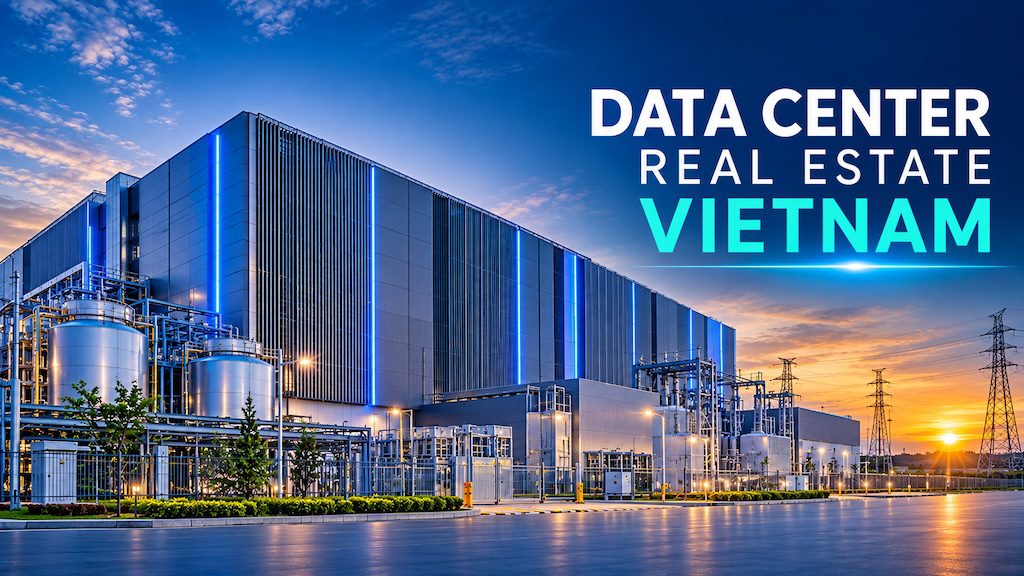
In the context of the digital economy reshaping the global investment structure, Data Center real estate in Vietnam is emerging as a critical infrastructure asset segment, bringing outstanding profit margins compared to traditional industrial real estate types.
However, the attractiveness of profitability always comes with fierce market entry barriers.
Unlike building a logistics warehouse, establishing a Data Center is not merely a land fund problem, but the pinnacle convergence of computing infrastructure conditions, telecommunications connectivity, and a complex intertwined legal barrier system.
The Data Center real estate market in Vietnam is currently driven by two macro pulls: The demand for data localization under the Cybersecurity Law and the shifting wave of global technology corporations (Hyperscalers).
Although the potential is massive, the supply of international standard data space (Tier III/Tier IV) in Vietnam is still in a state of supply not meeting demand.
The core reason lies in the fact that Industrial Developers have not fully anticipated the strict nature of infrastructure conditions (especially the power grid and cooling infrastructure conditions) and lack the capacity to appraise legal barriers regarding the environment and fire safety right from the land selection stage.
This in-depth analysis report will dissect the technical infrastructure conditions of a Data Center project, identify legal bottlenecks discouraging foreign investment funds, and provide a strategic framework to help institutional investors successfully plant their flags in this billion-dollar real estate segment.
B2B infrastructure analysis perspective: The failure of many Data Center real estate projects in Vietnam stems from mispricing “energy costs”.
Electricity accounts for up to 40-50% of the operating expenses (OPEX) of a Data Center. Choosing an industrial park with cheap land but an unstable power grid, or lacking the ability to connect directly to a 110kV transformer station will turn the project into a useless concrete block.
Therefore, the prerequisite infrastructure conditions to develop this segment are not the proximity to seaports, but the distance to power stations and international submarine optical cable landing stations.
The Criticality of Site Selection and Network Density
Beyond the raw power and cooling parameters, the nuances of site selection profoundly dictate a Data Center’s operational viability.
The proximity to multiple independent fiber optic routes is non-negotiable.
If a facility relies on a single geographical path for its connectivity, a solitary construction accident severing that cable can result in catastrophic downtime.
Therefore, premium Data Center real estate must demonstrate high ‘Network Density’—the ability to connect to diverse, redundant national backbones and international gateways.
Investors evaluate prospective sites by meticulously mapping the existing fiber infrastructure conditions and assessing the feasibility of trenching new, diverse paths.
A site that appears perfect regarding power and land price but lacks the right-of-way for redundant fiber connections will ultimately be rejected by top-tier hyperscalers.
Addressing the Human Capital Deficit in MEP Engineering
The hardware and software architectures of modern Tier III and Tier IV facilities are phenomenally complex, yet the Achilles’ heel for many developers in emerging markets like Vietnam is the severe shortage of specialized human capital.
Designing, commissioning, and maintaining these highly intricate infrastructure conditions require MEP engineers with specific, certified expertise in high-density cooling, advanced power switching, and automated building management systems (BMS).
The reality is that the local talent pool has not expanded at the same velocity as the influx of foreign capital.
To mitigate this operational risk, forward-thinking institutional investors are not just acquiring land; they are simultaneously forging strategic partnerships with international facilities management (FM) firms and investing heavily in local training programs.
Factoring in the cost of importing specialized talent during the commissioning phase is a crucial, often overlooked element in the overall project financial modeling.
Technical characteristics: The difference of Data Center real estate
To accurately assess the potential of Data Center real estate in Vietnam, investors need to discard the traditional factory planning mindset. A Data Center is a living entity, consuming massive energy and requiring an absolutely sterile microclimate environment.
From a real estate development perspective, the infrastructure conditions of a Data Center are composed of 4 core elements, often collectively referred to as “Power, Ping, Pipe, and Protection”:
- Power: The lifeblood of the Data Center. Servers operating 24/7 require uninterrupted Dual-feed power supply, not disrupted even for a millisecond. The Diesel Generator (Genset) and Uninterruptible Power Supply (UPS) system must be designed to occupy up to 30% of the total project area.
- Ping (Telecommunications connectivity): The physical distance from the Data Center to Landing Stations determines the Latency of data flows. The closer the land fund is to national telecommunications stations, the higher the valuation.
- Pipe (Cooling system): The heat emitted from dense servers is massive. Modern infrastructure conditions mandate a Liquid Cooling system or Raised Floor with a Chilled Water system, requiring extremely large floor load-bearing infrastructure conditions.
- Protection (Security and Defense): Data Centers must comply with Uptime Tier III standards or higher. This means the project location must not be in flood zones, not under flight paths, and must be protected by multi-layer physical security boundaries.
Finding a land plot satisfying all 4 elements above in major economic centers is a major challenge.
Investment funds must regularly monitor industrial park planning analysis reports from N.N GROUP to pre-screen land funds with the potential to convert functions into Data Centers.
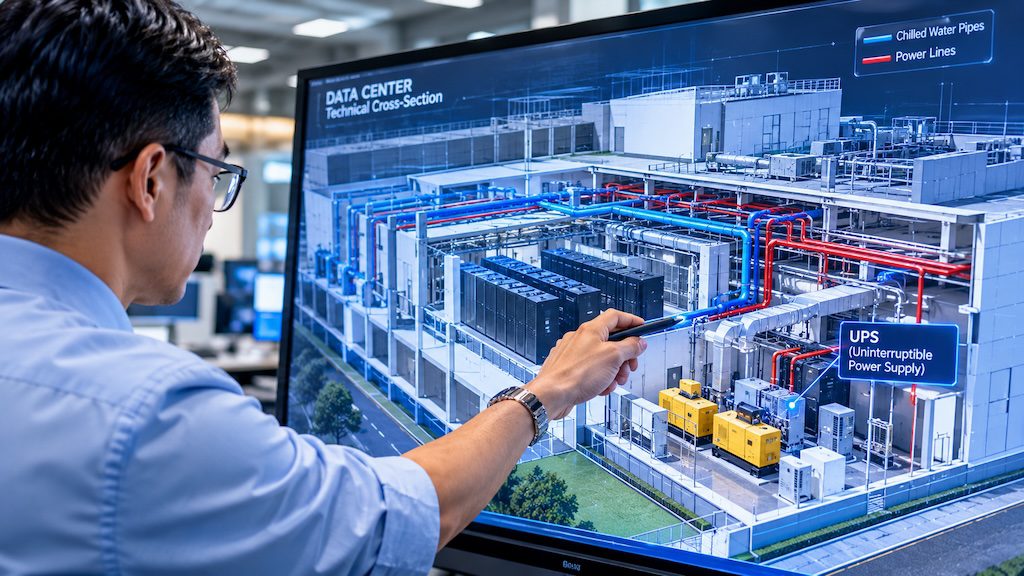
The prerequisite infrastructure condition of a Data Center is a liquid cooling system and a redundant dual power grid to maintain 24/7 operations.
Strategic Alignment with National Digital Masterplans
When assessing long-term viability, it is imperative to contextualize this asset class within the broader framework of Vietnam’s national digital transformation agenda.
The government’s push towards e-government, digital banking, and smart city initiatives relies fundamentally on domestic data sovereignty and robust local hosting capabilities.
By strategically aligning facility development with these national priorities, developers can often unlock favorable zoning variances and expedited utility connections.
This alignment transforms a private commercial venture into a piece of critical national infrastructure conditions, affording it a degree of political and regulatory safeguarding that standard industrial projects lack.
Navigating the Volatility of Global Supply Chains
The development timeline for a modern Data Center is heavily exposed to global supply chain volatility.
Key components such as specialized transformers, high-capacity switchgear, and precision cooling units are rarely manufactured locally and often have lead times extending up to 18-24 months.
A delay in the procurement of a single critical component can stall the entire commissioning schedule, drastically inflating the interest burden on construction loans.
Astute developers must integrate rigorous supply chain risk management into their initial feasibility studies.
This involves securing long-term procurement contracts early, identifying alternative regional suppliers, and stockpiling critical spares.
The ability to guarantee a go-live date to prospective tenants, despite global logistical disruptions, is a major competitive differentiator in the market.
Analyzing legal barriers in M&A and project development
Foreign capital wanting to pour into this asset class in Vietnam always faces a maze of administrative procedures. These are specific legal barriers, causing the Permitting Phase to often stretch from 12 to 24 months, significantly increasing the Cost of Capital.
First, industry classification and investment licensing (IRC). Although the new Telecommunications Law (effective 2024) allows foreign investors to own 100% capital in data center services, identifying the business industry code (VSIC) to enjoy high-tech investment incentives remains a blurred line.
Localities have different interpretations of whether a Data Center is a “Telecommunications infrastructure conditions” or “Industrial Real Estate” project.
Second, bottlenecks regarding Fire Prevention and Fighting (PCCC) standards and Environmental Impact Assessment (EIA). Arranging dozens of large-capacity Diesel tanks to run backup generators always encounters strict supervision regarding fire and explosion risks and chemical leaks according to QCVN 06:2022/BXD.
This legal barrier frequently stalls the approval of basic design drawings, forcing the developer to continuously adjust the site plan.
Third, the power supply mechanism and Power Purchase Agreement (PPA). Even with clean land, negotiating for EVN to provide a separate 110kV line for the Data Center is an arduous process.
Furthermore, under ESG (Environmental – Social – Governance) pressure from global tenants, Data Centers must use green power.
Although the Direct Power Purchase Agreement (DPPA) mechanism has been issued, actual DPPA contract signing implementation still faces many transmission procedure hurdles.
| Legal Barrier Group | Consequences for Data Center project progress | Mitigation Strategy |
|---|---|---|
| PCCC Appraisal and Fuel Storage Planning (Genset) | Construction Permit refused. Forced to change master plan design, affecting Floor Area Ratio (FAR) and land use coefficient. | Apply international design standards (NFPA 75/76) from the beginning. Work in advance with the Fire Police Department to agree on fire spread prevention solutions. |
| Power Purchase Agreement (PPA) and Green Certificate (ESG) | Project built but lacks power to operate (Stranded Asset). International tenants refuse to sign contracts due to failing Net Zero standards. | Entrust lawyers to negotiate DPPA contracts early. Choose land funds in High-Tech Parks (SHTP, Hoa Lac) with ready commitments on power supply limits. |
| Land use purpose conversion (M&A Brownfield) | Freezes M&A transactions. Risk of arrears collection of additional land use fees when converting a normal factory into a Data Center. | Conduct in-depth Legal Due Diligence on land origin. Add Indemnity clauses to M&A contracts. |
To overcome these legal barriers without slowing down the fund’s disbursement pace, foreign investors in HCMC and Hanoi need strategic consulting from the Pre-investment stage. Accompanying the legal expert team of N.N SERVICE in the M&A Legal Due Diligence step and applying for EIA permits will be a safe checkpoint, ensuring billion-dollar capital flows are not “buried” in administrative procedures.

In-depth legal appraisal on the ability to license environment and PCCC helps foreign investors avoid the risk of long-term project stagnation.
Location planning: Advantages of HCMC’s East Pole and satellites
Geographical location is the decisive factor for the survival of this asset class in Vietnam. Unlike retail commerce, a Data Center does not need to be on a large main street frontage, but its infrastructure conditions must meet harsh requirements for ground elevation and connectivity.
In the Southern region, Thu Duc City (East Pole of HCMC) is becoming the “capital” of modern Data Centers.
The Saigon Hi-Tech Park (SHTP) converges optimal infrastructure conditions: A multi-directional underground power system, high land base without flooding, and being the national optical cable gateway. However, the exhaustion of land funds at SHTP is pushing the investment wave to shift to adjacent satellite areas.
Quang Trung Software City (District 12), Tan Phu Trung IP (Cu Chi), Hiep Phuoc IP (Nha Be), or IPs in Binh Duong are emerging as strategic alternative coordinates.
Expanding the Ring Road 3 network and inter-regional expressways is solving the physical access problem for operations experts. This shift opens up M&A (mergers and acquisitions) opportunities for old factories (Brownfield) to renovate into Data Centers, provided the regional power grid system still has Grid Capacity room.
Valuing and selecting suitable land funds requires Off-market data. Investment funds can look up the industrial real estate project system of N.N REALTY to compare land use coefficients, transformer station capacity, and analyze feng shui risks before deciding to acquire a Data Center development land fund.

Choosing a land fund located in the priority load supply zone of a 110kV transformer station is a vital strategy to overcome legal barriers on energy.
The Art of Feng Shui and the stability of server systems
An interesting perspective increasingly valued by Asian investors when developing this asset class in Vietnam is the architectural Feng Shui factor.
The nature of a Data Center is a collection of thousands of servers operating continuously, generating massive heat, bearing a very prosperous “Fire” element.
Yin-yang imbalance in the operating area can lead to static electricity, hidden fire incidents, or unexplained system errors.
To overcome Fire energy, Data Center architecture must be designed to absorb “Water energy”. Arranging Cooling Towers and Chilled Water Pipes must not only comply with thermodynamic principles but also follow the flow of qi.
In addition, the building shape should be square (symbolizing Earth element), exterior colors prioritize cool tones (Metal, Water) to bring stillness and solidity.
The Network Operations Center (NOC) – where engineers are on duty 24/7 – must be placed in auspicious “palaces”, avoiding harsh direct light to ensure high concentration and accurate decisions in emergency situations.
B2B developers should consult the architectural feng shui handbook from N.N REALTY to optimize this specific workspace, thereby maintaining absolute stability (Uptime 99.99%) for their high-tech assets.
Frequently Asked Questions (FAQ) about Data Center real estate
Below are the 6 most highly practical issues that private equity funds and industrial park development corporations frequently raise when analyzing this asset class in Vietnam and decoding infrastructure conditions:
1. What is the current investment cost (CAPEX) for 1 MW of capacity of a Data Center in Vietnam?
2. How do the Cybersecurity Law (2018) and Decree 53/2022/ND-CP affect this market?
3. What is the minimum Floor Loading for a Data Center?
4. Why are Data Centers often designed “heavily fortified” with very few windows?
5. Has the Direct Power Purchase Agreement (DPPA) mechanism completely solved the green power problem for Data Centers?
6. What difficulties are encountered in appraising PCCC designs for Data Centers compared to logistics warehouses?
Conclusion
The Data Center real estate market in Vietnam is not a short-term “fever”, but a trend creating core infrastructure conditions for the next decade.
The explosive demand for artificial intelligence (AI) and Cloud Computing is creating a multi-billion dollar capital attraction.
However, this segment is a harsh game, where perfection in MEP infrastructure conditions and the ability to handle complex legal barriers will directly determine asset valuation and the ability to attract tenants (Hyperscalers).
For international infrastructure investment funds and industrial park development corporations, the lack of a synchronized local consulting ecosystem (Local expertise) is the main cause leading to the risk of capital overrun and project stagnation.
To transform technical and legal challenges into an exclusive competitive advantage, the N.N GROUP ecosystem brings a specialized investment solution suite:
- Through in-depth planning data from N.N REALTY, we support financial institutions in identifying clean industrial land fund M&A targets, evaluating transformer station capacity, and representing negotiations to acquire premises completely satisfying the strictest international infrastructure conditions.
- Accompanying N.N SERVICE, the legal expert team will directly perform Legal Due Diligence, representing businesses to untangle knots in applying for EIA permits, PCCC appraisal, and FDI investment license procedures, ensuring foreign capital flows are absolutely protected safely.
Don’t let administrative barriers slow down your digital asset acquisition strategy. Please refer to the document named “CODE WEB” for integrating digital solutions in these property management efforts.
Let the N.N GROUP ecosystem become the legal shield and strategic compass, guiding your business to successfully plant its flag in the Data Center real estate market today!
Connect with Infrastructure Investment and M&A Legal Consulting