


Repatriation of Profits by FDI Enterprises: Legal Requirements and Tax Procedures in 2026

The ultimate goal of any multinational corporation or foreign direct investment (FDI) enterprise when entering the Vietnamese market is profitability. However, generating profit on the Profit and Loss (P&L) statement is only half the battle. The other half—and also the most arduous journey—is how to execute profit repatriation Vietnam legally, optimally in terms of time, and without depletion from penalty sanctions.
Macroeconomic realities show that Vietnam’s legal system is increasingly integrating deeply, creating a clear corridor for FDI flows. Despite this, foreign exchange management and FDI tax procedures are still strictly controlled to combat transfer pricing, tax base erosion, and tax evasion. Failure to firmly grasp the legal conditions can lead to millions of dollars of a business being “stuck” in the domestic banking system, causing a disruption in the parent company’s cash flow.
This in-depth article is designed as a comprehensive financial legal handbook specifically for Chief Financial Officers (CFOs), Chief Executive Officers (CEOs), and Chief Accountants of foreign enterprises operating in HCMC. We will detail the mandatory legal conditions, the implementation roadmap for FDI tax procedures, and the key risks to avoid so that the profit repatriation Vietnam process takes place as smoothly and transparently as possible.
Macro analyst’s perspective: A classic mistake of many foreign businesses is equating “Accounting profit” with “Profit allowed to be remitted”. According to regulations, profit repatriation Vietnam is only performed on the remaining amount after fulfilling 100% of financial obligations to the Vietnamese State. A lack of documents proving legal conditions or errors in FDI tax procedures can lead to the authorities immediately freezing international money transfer transactions.
Determine the nature of income allowed to be remitted
Before starting to prepare the dossier for FDI tax procedures, investors need to clearly determine the nature of the cash flow they want to remit to their home country. According to Circular No. 186/2010/TT-BTC of the Ministry of Finance guiding profit repatriation Vietnam for foreign organizations and individuals, legal profit is determined to include:
- Profits distributed or obtained from direct investment activities in Vietnam under the Investment Law, after fully completing Corporate Income Tax (CIT) obligations and other financial obligations.
- Reinvested profits in Vietnam (if the business decides to recover this reinvested capital).
- Surplus funds from asset liquidation and investment project termination (after deducting all debts and related obligations).
Especially, for profit repatriation Vietnam, businesses are not allowed to remit an amount greater than the undistributed accumulated profit on the audited Financial Statements. If the current year’s Financial Statement shows a profit, but when combined with the accumulated losses of previous years the total profit fund is still a negative number (below 0), then the investor absolutely does not meet the legal conditions to execute the money transfer.
3 Prerequisite FDI Legal Conditions for legal money transfer
Navigating capital flows out of Vietnam’s borders cannot be done arbitrarily with a bank transfer order. For the commercial banking system to accept the transaction, the business must prove it has overcome the 3 extremely strict legal condition barriers below. These are also the bottlenecks where many businesses frequently get stuck when executing FDI tax procedures.
| FDI Legal Condition Item | Core Requirement & Proof of executing FDI tax procedures |
|---|---|
| 1. Fulfillment of financial obligations (Tax) | The business must pay in full Corporate Income Tax (CIT), Value Added Tax (VAT), foreign contractor tax (if any) and have no outstanding fines or late tax payment penalties. The tax authority will cross-check the system before confirming the FDI tax procedures. |
| 2. Audited Financial Statements | For profit repatriation Vietnam, the Financial Statement of the year the income arises (or the FS upon project termination) MUST be audited by a legal independent auditing firm in Vietnam. Self-prepared reports are not accepted. |
| 3. Positive accumulated profit | The allowed remittance amount must not exceed the undistributed accumulated profit (after fully offsetting the losses of previous years according to loss carryforward regulations in FDI tax procedures). |
Besides the 3 pillars above, an implicit but decisive legal condition is the legality of the Direct Investment Capital Account (DICA). The profit cash flow must be transferred from the business’s payment account to the DICA Account, and only then from the DICA Account to the parent company’s account abroad. Diverting cash flows without going through DICA will seriously violate the Ordinance on Foreign Exchange.
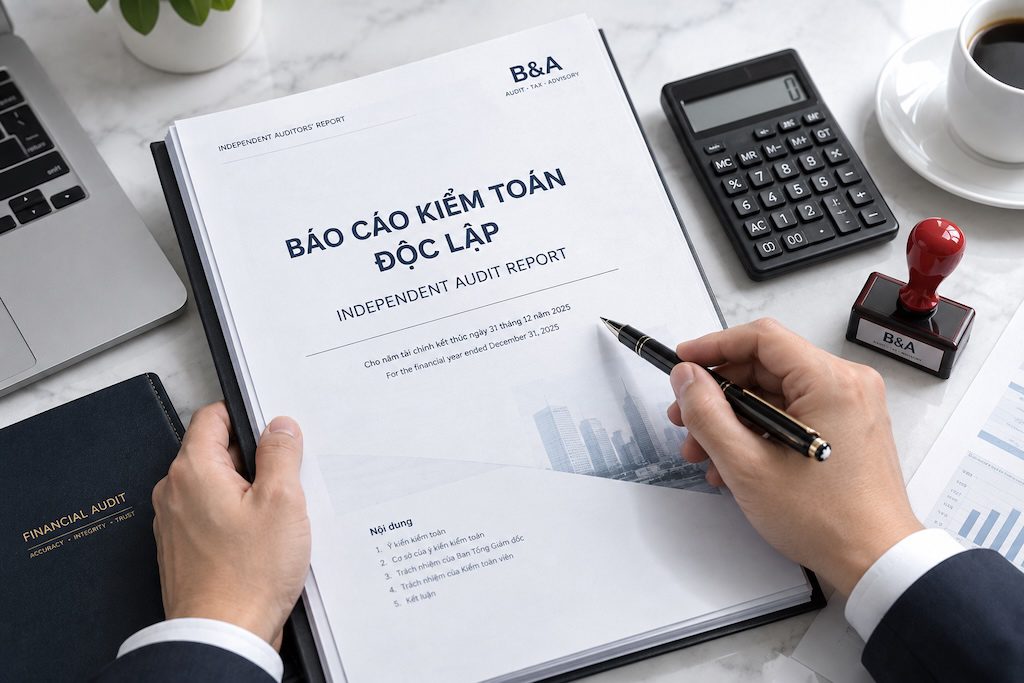
An independently audited Financial Statement is a mandatory condition to prove the legality of the profit source.
FDI tax procedures process: Execution steps from A-Z
Once certain the business meets all legal conditions, the next step is executing FDI tax procedures with the management agency. Profit repatriation Vietnam is divided into two forms: Annual remittance (after the end of the financial year) and Remittance upon project termination. Below is the standard roadmap for annual income remittance:
Step 1: Closing the books and Auditing Financial Statements
Immediately after December 31 (end of the financial year), the chief accountant must finalize the books. The business invites an independent auditing unit to work. This process helps eliminate invalid expenses, accurately determines the CIT payable, and creates a solid foundation to avoid disallowance when undergoing FDI tax procedures.
Step 2: Complete Tax Finalization and Tax Payment
No later than the last day of the 3rd month from the end of the calendar year (usually March 31), the business submits the CIT finalization dossier and pays the full incurred tax amount into the State Treasury. It is advisable to use macro newsletters from N.N GROUP to update on tax payment extension policies (if any).
Step 3: Send Notification of profit repatriation Vietnam
This is the core step in FDI tax procedures. Investors must prepare a Notification of profit repatriation Vietnam (according to the prescribed form) and send it directly to the Tax authority directly managing the business. This notification must be submitted at least 07 working days prior to the expected date of executing the money transfer order at the bank.
Step 4: Execute money transfer order at the Commercial Bank
After the 07 working day period expires from the date the Tax authority receives the Notification (and the Tax authority has no written request to stop or further explain), the business brings the dossier set to the commercial bank to execute the foreign currency transfer order. Bank dossiers usually include:
- Notification of profit repatriation Vietnam with the Tax authority’s receipt stamp.
- Audited Financial Statements.
- CIT finalization declaration and tax payment receipt (State Budget remittance voucher).
- Minutes of the Board of Members/Board of Directors meeting regarding dividend/profit distribution.
| Execution phase of FDI tax procedures | Mandatory Legal Deadline | Necessary actions by the FDI apparatus |
|---|---|---|
| Tax Auditing & Finalization | Before March 31 annually (or the 90th day of the following financial year). | Close accounting books, finalize audited FS, submit declaration, and pay CIT to satisfy legal conditions. |
| Send Notification to Tax Authority | Minimum 07 working days before the money transfer date. | Prepare a valid Notification form for profit repatriation Vietnam, submit via the eTax system. |
| Bank Transfer Order | After 07 working days from the date of Tax receipt. | Provide the original dossier set to the commercial bank where the DICA capital account is opened to buy foreign currency and transfer it. |
A deep understanding of FDI tax procedures is a vital advantage. Through the N.N GROUP consulting ecosystem, businesses will minimize the risk of dossiers being rejected by banks due to missing documents proving basic legal conditions.

Advice from financial experts helps FDI enterprises eliminate the risk of dossiers being rejected by banks.
Risk management: Invalid expenses and transfer pricing traps
An alarming hidden corner when mentioning FDI tax procedures and the process of profit repatriation Vietnam is the risk of having expenses disallowed by the Tax authority and facing Transfer Pricing inspections. This directly affects the legal conditions of the project.
Many businesses want to maximize the amount of profit repatriation Vietnam and have thus tried to falsely declare management fees from the parent company, royalty fees, or internal loan costs. However, from the perspective of Vietnamese law, these related-party transactions carry an extremely high risk of inspection.
According to Decree 132/2020/ND-CP, if a business cannot prove the commercial nature (Arm’s length principle) of related-party transactions, the Tax authority has the right to reassess the price, eliminate invalid expenses, and collect tax arrears (CIT). At that time, not only is the amount allowed for profit repatriation Vietnam significantly narrowed, but the business also faces massive administrative fines, losing the “no tax debt” legal condition mentioned in Step 1.
Book transparency is the ultimate standard. Businesses must strictly comply with Vietnamese Accounting Standards (VAS). Instead of taking the “beaten path”, investors should use a legal financial structure under the guidance of experts who understand the regulations of FDI tax procedures.
Opportunities from Real Estate and M&A to optimize cash flow
When profit repatriation Vietnam faces difficulties due to exchange rate barriers or a strategy to retain capital for reinvestment, Chief Financial Officers (CFOs) often seek safe asset haven channels in HCMC. Among them, Mergers and Acquisitions (M&A) and investing in commercial real estate is the most supreme strategy.
Accumulated profits, instead of undergoing FDI tax procedures for repatriation to the home country, can be used to increase charter capital, thereby acquiring (M&A) industrial land funds or long-term leasing ESG-standard Grade A office buildings. Vietnamese law encourages this reinvestment capital flow by exempting many complex procedures compared to transferring money internationally. However, to ensure legal conditions during business expansion via M&A in HCMC, businesses need to pay attention to the system of “Sub-licenses”.
Investing in commercial space not only helps preserve cash flow value against inflation but also creates a solid operating cost (Opex) structure, optimizing CIT obligations for subsequent financial years. Businesses can consult the commercial space architecture handbooks from N.N REALTY to position real estate assets worthy of the organization’s status.

Reinvesting profits in Grade A commercial space is the optimal solution for long-term cash flow.
Frequently Asked Questions (FAQ)
Below are the 6 most practical questions related to FDI tax procedures and the process of profit repatriation Vietnam that international investors frequently ask when working with the N.N GROUP ecosystem in HCMC:
1. Based on current law, can I execute profit repatriation Vietnam multiple times in one financial year?
No. For profits generated in the active financial year, businesses are NOT allowed an advance profit repatriation Vietnam during the year. The money transfer is only executed once at the end of the year (after the financial year ends, has been audited, and CIT is fully paid).
2. If the current year’s Financial Statement shows a 10 billion profit, but the previous year’s accumulated loss is 12 billion, can I remit this 10 billion?
Absolutely not. According to FDI tax procedures standards, the profit remitted must be the undistributed accumulated profit at the end of the period. In this case, after offsetting (10 – 12 = -2 billion), the business’s profit fund is still negative. Therefore, you do not meet the legal conditions to execute the money transfer.
3. When submitting the Notification of profit repatriation Vietnam, will the Tax authority return an approval document?
Under current FDI tax procedures, the Tax authority DOES NOT issue an “Approval” or “Permission” document. They only stamp “Received” on the business’s Notification. The commercial bank will rely on this receipt stamp and the expiration of the 07 working day period to disburse the foreign currency transfer order.
4. Do I have to pay foreign contractor tax (FCT) on the amount of profit repatriation Vietnam?
No. For income from dividend distribution and after-tax profit of foreign investors that are organizations, Vietnamese law currently DOES NOT collect tax on profit repatriation Vietnam (0% tax rate). This is a very preferential condition to attract international investment flows.
5. Can I use a VND current account to execute profit repatriation Vietnam?
This violates foreign exchange management regulations. Profits in VND must be used to purchase foreign currency at a commercial bank, then it must be transferred into the Direct Investment Capital Account (DICA), and only then from DICA can profit repatriation Vietnam to the parent company occur. Current accounts do not have this function.
6. How to resolve it if the money transfer dossier is rejected by the bank due to unclear FDI tax procedures?
To ensure transparency compliance, you need to review the entire Board of Directors meeting minutes on dividend distribution and the CIT finalization declaration. If the bank requests further explanation, it is best to have a senior accounting expert from a reputable organization reappraise the dossier to avoid cash flow stagnation risks.
Conclusion: Confidently control cash flow with the N.N GROUP ecosystem
Understanding and strictly complying with the principles of FDI tax procedures is the core foundation for multinational corporations to protect their business achievements after a hard working cycle. Acumen in applying legal conditions is the master key helping businesses unblock financial flows, executing profit repatriation Vietnam in an absolutely safe and legal manner.
To completely eliminate risks of disallowed expenses, optimize cash flow structures, and reposition reinvestment strategies in the Vietnamese market, the companionship of an “All-in-One” B2B consulting ecosystem like N.N GROUP is a vital prerequisite for every foreign enterprise:
- Through N.N SERVICE, our team of chief accountant experts and senior lawyers will directly perform internal audits, review books, and prepare standard tax finalization declarations. We prepare the entire FDI tax procedures dossier on behalf of the business, submit the Notification to the Tax authority, and directly explain to the Commercial Bank, ensuring all legal conditions are perfectly met so the profit repatriation Vietnam process runs as smoothly as possible.
- Synchronizing with N.N REALTY, if the corporation has a strategy to retain profits to acquire market share, we provide transparent data and directly represent you in searching for Grade A commercial real estate (ESG) in District 1 or land funds in SHTP, helping businesses transform cash flows into strategic assets with outstanding profitability.
Don’t let potential legal risks and the complexity of administrative procedures disrupt your organization’s global cash flow. Let the N.N GROUP ecosystem become your strategic partner, protecting finances and creating the safest profit repatriation path for your business today!