

Global Minimum Tax in Vietnam: FDI Strategies for 2026
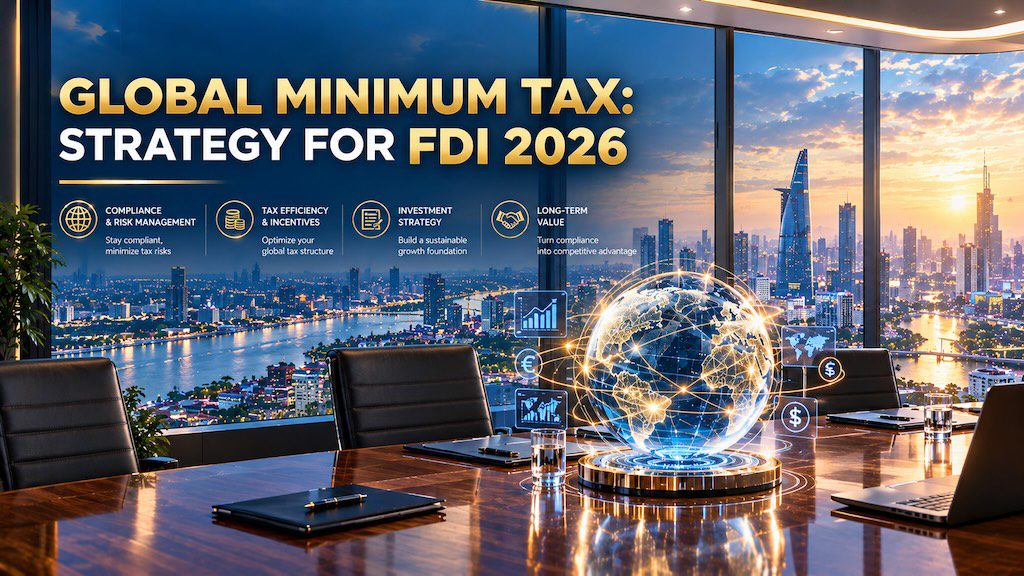
Over the past two decades, the corporate income tax (CIT) incentive policy – especially the tax holiday mechanism – has always been the most powerful “magnet” helping Vietnam successfully attract hundreds of billions of USD in foreign direct investment (FDI) flows.
However, the world’s financial architecture is undergoing a historic overhaul. The emergence of the global minimum tax in Vietnam (under Pillar 2 of the BEPS framework initiated by the OECD) officially marks the end of the era of competing for capital by racing to lower tax rates.
For multinational enterprises (MNEs) setting up headquarters and manufacturing facilities in Ho Chi Minh City (HCMC), the global minimum tax impact is not merely an arithmetic operation on the P&L statement. It is a macroeconomic “shock” requiring comprehensive intervention—from restructuring the supply chain and re-evaluating commercial real estate investments to establishing an entirely new FDI response strategy.
The following in-depth article will dissect the whole picture of the global minimum tax in Vietnam, analyze key risks for foreign businesses in the HCMC economic hub, and outline a strategic roadmap to help form an FDI response strategy to protect net profit margins in this strict integration era.
Macro-financial expert’s perspective: The application of the global minimum tax in Vietnam is not a step back for the investment environment, but a necessary “filter” to upgrade the quality of FDI inflows.
This process, driven by the global minimum tax impact, will eliminate processing projects only seeking tax havens and retain investors truly interested in infrastructure, human resources, and the transparent legal ecosystem in HCMC. Building an FDI response strategy from now on will depend on practical governance capacity rather than relying on State protection.
Overview of the global minimum tax in Vietnam
To clearly understand the root of the global minimum tax impact, we need to review the core rules of Pillar 2 led by the Organization for Economic Cooperation and Development (OECD), which has received consensus from over 140 countries and territories. The ultimate goal of this mechanism is to combat base erosion and profit shifting to “tax havens” with zero or very low tax rates. Shaping a smart FDI response strategy is vital.
Accordingly, the global minimum tax in Vietnam is shaped based on an immutable principle: Any multinational company with consolidated global revenue of 750 million EUR (about 800 million USD) or more in at least 2 of the 4 preceding years will be subject to a minimum Effective Tax Rate (ETR) of 15% in every country where they operate.
The legal story gets complicated when projected into reality. For years, to attract tech “eagles”, HCMC has granted numerous Investment Certificates at the Saigon Hi-Tech Park (SHTP) with extremely attractive CIT incentives: 4-year tax exemption, 50% reduction for the next 9 years, and a preferential tax rate of 10% for 15 years. This makes the effective tax rate of many FDI groups in Vietnam fluctuate around 3% to 7%.
When the global minimum tax in Vietnam officially takes effect, if Vietnam only collects 5% tax from businesses, the country where the parent company is headquartered (e.g., Japan, South Korea, the US) will have the right to collect the remaining 10% (Top-up Tax) to hit the 15% mark. This event renders all committed tax incentive packages meaningless, generating an extremely heavy global minimum tax impact on investor psychology. A proactive FDI response strategy is essential.
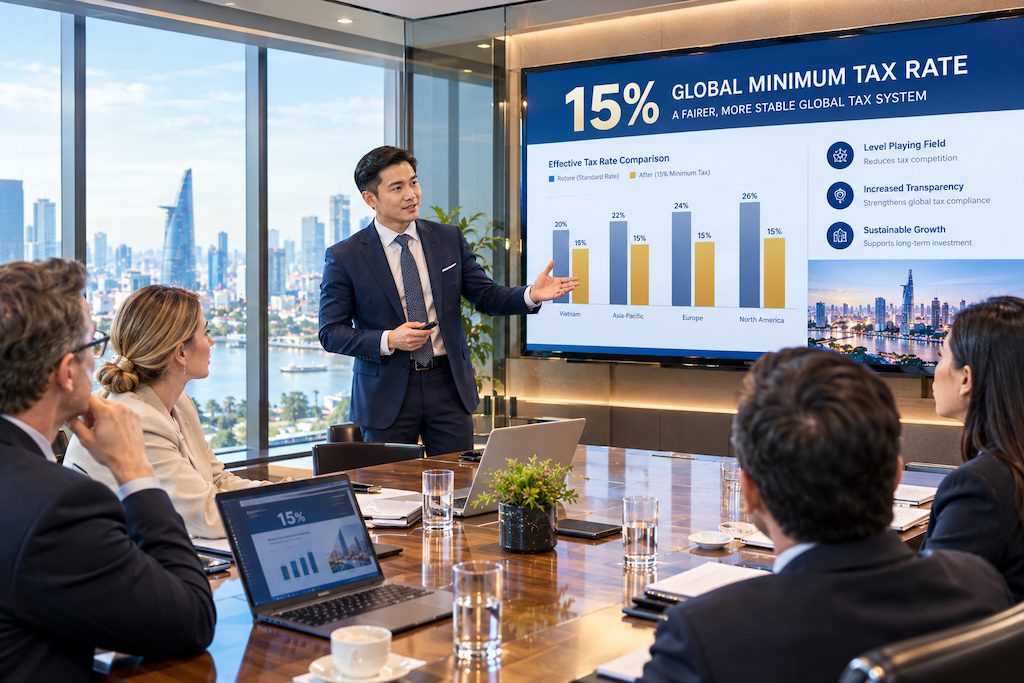
In-depth financial consulting is the key to building a safe and legal FDI response strategy.
Scope of application and telling numbers in HCMC amid the global minimum tax impact
According to data from the Ministry of Finance and international auditing organizations, the global minimum tax in Vietnam will directly affect over 120 large-scale MNEs. In the Southern region, HCMC and neighboring provinces like Binh Duong and Dong Nai are the epicenters of this change, as they densely concentrate electronics, semiconductor, and high-tech manufacturing supply chains.
To quantify the global minimum tax impact, FDI enterprises must clearly define their position through the classification matrix below, thereby establishing an accurate FDI response strategy:
| FDI Enterprise Target Group | Impact Level & Actual Impact |
|---|---|
| MNEs with revenue > 750 million EUR | Direct and severe global minimum tax impact. All CIT exemption/reduction packages currently enjoyed at SHTP or Export Processing Zones will be neutralized. Businesses are forced to pay the top-up tax to reach 15%. |
| Small & Medium FDI Enterprises (SMEs) | No direct global minimum tax impact. Companies with revenues under 750 million EUR continue to enjoy the current tax incentives of Vietnam, bypassing the global minimum tax in Vietnam. |
| Supporting industry enterprises (Tier 1, 2 Vendors) | Indirect global minimum tax impact (Supply chain). When parent “eagles” face increased tax costs, they will pressure vendors in Vietnam to lower processing prices to offset profit margins, indirectly squeezing the supporting ecosystem’s cash flow. |
| Commercial Real Estate Investment Enterprises | Repositioning opportunity. When tax incentives are no longer the unique advantage, ESG-standard Grade A offices and green factories will become new magnets in a modern FDI response strategy. |
Thus, the FDI response strategy can no longer be entrusted solely to the accounting department, but requires the Board of Directors’ involvement in redesigning the entire Operating Model to mitigate the global minimum tax impact in the Vietnamese market.

Changing the FDI response strategy entails a shift in demand for Grade A office space in HCMC due to the global minimum tax impact.
QDMTT – The Government’s solution to the global minimum tax impact
Facing the risk of losing competitiveness and “bleeding” tax revenues to developed countries, the Vietnam National Assembly has had extremely fierce and timely legislative reactions. To neutralize the global minimum tax impact, Vietnam has officially approved the application of the Qualified Domestic Minimum Top-up Tax (QDMTT).
The nature of QDMTT in the picture of the global minimum tax in Vietnam is a strategic defensive move. Accordingly, instead of letting the parent company pay the top-up tax to the foreign government, Vietnam will directly collect this additional tax right in the domestic market to ensure the ETR reaches 15%. This ensures Vietnam’s legal taxation right is not stripped away.
However, if only collecting more money, the investment environment would immediately lose its appeal. Therefore, the brightest spot in the national FDI response strategy is the establishment of the Investment Support Fund, extracted from this very QDMTT revenue. Cash flows will be reallocated for direct Cash grants or cost offsets for FDI enterprises, rather than tax incentives like before. Sponsored categories include:
- Support for high-tech human resource training costs in HCMC.
- Direct funding for Research and Development (R&D) costs to offset the global minimum tax impact.
- Support for green infrastructure, renewable energy, and environmental treatment investment costs.
The transition from “Tax exemption” to “Cost funding” marks a turning point in economic management thinking, requiring the FDI response strategy of corporations to pivot towards detailed Opex and Capex accounting to maximize support funds from the Government.
Restructuring business space and supply chains under the global minimum tax in Vietnam
When the global minimum tax in Vietnam overshadows the advantage of “incentive havens”, foundational core values will take the throne. For FDI corporations in HCMC, physical space and commercial real estate are the most sustainable, long-term FDI response strategy.
Real estate is not just a workplace; it constitutes a huge part of Deductible expenses and directly affects the criteria for receiving support from the Investment Support Fund. Relocating from congested, polluted areas to ESG-standard Grade A office buildings in the District 1 financial center or Thu Thiem New Urban Area will help businesses score absolute points in the Government’s R&D funding assessments.
To chart a roadmap to overcome the global minimum tax impact, CFOs and Chief Strategy Officers can refer to the operational restructuring table below:
| Execution Phase | Strategic Actions of FDI Enterprises | Expected Goals |
|---|---|---|
| Phase 1: Impact Assessment & Financial Modeling | Recalculate the Effective Tax Rate (ETR) according to the Global Anti-Base Erosion (GloBE) rules. Review all R&D and personnel costs being implemented at the Vietnam branch. | Accurately identify the top-up tax scale under QDMTT, avoiding penalties associated with the global minimum tax impact. |
| Phase 2: Repositioning Commercial Real Estate | Liquidate inefficient lease contracts. Collaborate with N.N REALTY brokerage experts to find LEED/Lotus standard Grade A offices, optimizing Opex. | Meet global ESG standards, maximizing cash grants as an optimal FDI response strategy. |
| Phase 3: Domestic Supply Chain Optimization | Shift some processing production stages from other countries back to Vietnam to enhance the “substance” of the business establishment, increasing deductible labor costs. | Maximize the Substance-Based Income Exclusion (SBIE) to minimize the payable tax. |
A deep understanding of the commercial space market is a vital advantage. Through N.N REALTY, FDI enterprises will access exclusive data on Grade A space planning in HCMC, thereby making wise leasing decisions, turning office rent into a sharp tool in the FDI response strategy against the global minimum tax impact.
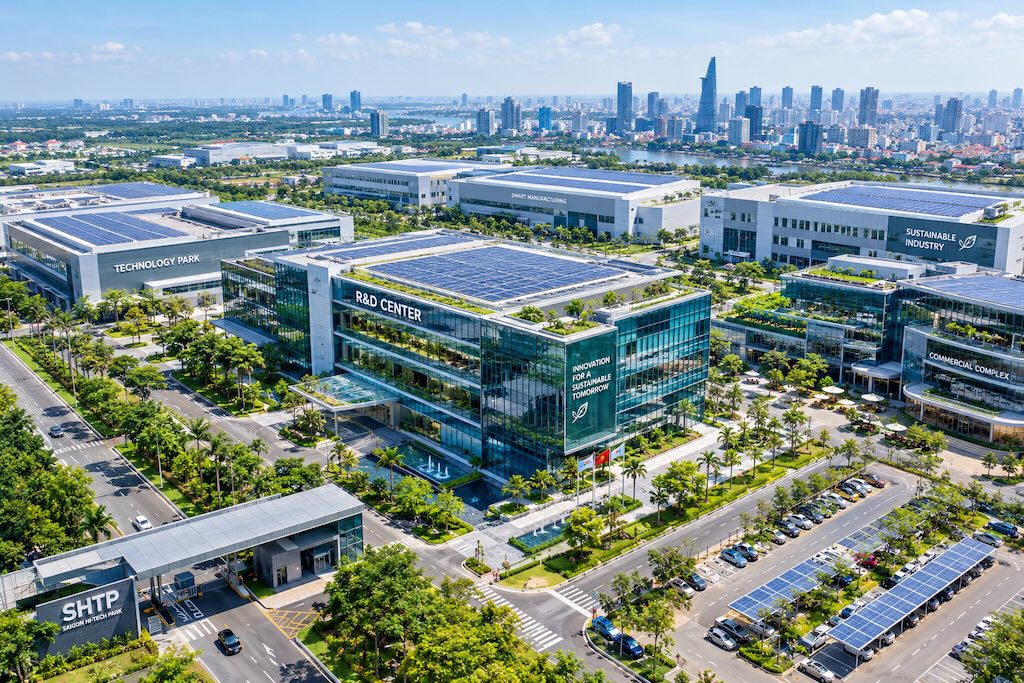
Projects at SHTP are transforming their incentive-receiving models to adapt to the new tax law and the global minimum tax in Vietnam.
FDI response strategy: From financial reports to legal execution
Facing the wave of the global minimum tax in Vietnam, legal compliance and financial reporting transparency are the strongest shields. A modern FDI response strategy no longer focuses on “loophole” finding or Transfer Pricing, but revolves around accurate internal accounting capacity.
Businesses must pay special attention to preparing ETR calculation dossiers following International Financial Reporting Standards (IFRS) and compatible with the Vietnamese Accounting Standards (VAS). Accurately determining the Substance-Based Income Exclusion (SBIE) based on tangible asset values (like factories, machinery, commercial real estate) and salary costs for personnel in HCMC will help businesses deduct a significant income amount before being subjected to the 15% rate.
More than ever, the global minimum tax impact requires an urgent risk management system. Any errors in submitting the GloBE Information Return (GIR) or delays in updating implementation decrees from the General Department of Taxation can lead to severe legal consequences.
Accompanying professional FDI legal, accounting, and auditing consulting units like N.N SERVICE will provide CFOs with a comprehensive risk diagnostic toolkit, ensuring legal compliance at the highest level, while sharply and validly designing applications for the Investment Support Fund.
Frequently Asked Questions (FAQ) regarding the global minimum tax in Vietnam
Below are the 6 most practical questions related to the global minimum tax in Vietnam and the FDI response strategy that international investors frequently ask when working with the N.N GROUP ecosystem in HCMC:
1. My FDI business has a revenue of 500 million USD, will the global minimum tax in Vietnam be applied?
No. This mechanism only applies to multinational corporations with consolidated global revenue of 750 million EUR (equivalent to about 800 million USD) or more in at least 2 of the 4 preceding years. If below this level, you still enjoy normal incentives.
2. What is QDMTT and why does Vietnam apply it to deal with the global minimum tax impact?
QDMTT (Qualified Domestic Minimum Top-up Tax) is a mechanism allowing Vietnam to collect the tax difference (to reach 15%) right in the domestic market instead of letting the parent company’s country collect it. This helps Vietnam retain taxation rights and have revenue to establish the Investment Support Fund.
3. Does the shift to receiving cash grants instead of tax incentives increase inspection risks dealing with the global minimum tax in Vietnam?
Receiving funding from the Government requires extremely high transparency. Businesses must prove that R&D costs, personnel costs, and green development spending are real and valid. This requires an FDI response strategy combined with an extremely tight internal audit system.
4. Do commercial real estate and office leasing costs help reduce the top-up tax payable?
Yes, partially. According to the Substance-Based Income Exclusion (SBIE) regulations, businesses are granted a certain percentage deduction based on the value of tangible assets (including land use rights, factories, offices) and employee salary costs in the host country when calculating the payable tax.
5. Which sectors does Vietnam’s Investment Support Fund prioritize to soften the rules of the global minimum tax in Vietnam?
This Fund prioritizes supporting high-tech application projects, high-tech product manufacturing (like semiconductor chips, AI), Research & Development (R&D) centers, and investment projects for green infrastructure development and environmental treatment. Ordinary labor-intensive processing projects will find it hard to access this fund.
6. What is the core solution for building an FDI response strategy in the current period?
The core solution is shifting from “tax competition” to “real value competition”. Businesses need to restructure assets, upgrade ESG-standard office spaces, and establish standard IFRS Financial Reporting systems under the advice of experts who understand local laws.
Conclusion: Stepping firmly into a new era with the N.N GROUP ecosystem
The presence of the global minimum tax in Vietnam is not the end of the investment environment’s attractiveness, but a mandatory push for the economy to transform. For multinational corporations, overcoming the global minimum tax impact requires a flexible financial governance mindset, smart business space planning, and an FDI response strategy based on absolute legal compliance.
In an era where all financial parameters are transparently disclosed and strictly evaluated, choosing a reputable local partner who deeply understands the legal system and real estate market is the golden key to help businesses rise to the top. The N.N GROUP ecosystem proudly offers a comprehensive “All-in-One” B2B solution suite, seamlessly connecting physical assets and legal foundations:
- Initialize physical advantages with N.N REALTY: Our team of experts will help you evaluate, screen, and negotiate to own/lease ESG-standard Grade A office spaces in District 1, Thu Thiem, or industrial land funds at SHTP. Optimizing the real estate portfolio is the first step to increasing the valid cost structure, consolidating your position when facing the global minimum tax in Vietnam.
- Protect cash flows with N.N SERVICE: Our team of senior lawyers and auditors will act as a solid “shield”, assisting businesses in establishing internal control processes, preparing ETR reports, applying for investment licenses, and directly consulting on strategies to receive support from the Government’s Investment Support Fund, ensuring businesses are always proactive against the global minimum tax impact.
Don’t let global tax law risks slow down your organization’s development pace. Let the N.N GROUP ecosystem become your strategic partner, protecting assets and executing a flawless FDI response strategy against the global minimum tax in Vietnam today!