


Real estate transfer tax from July 1, 2026: 2% rate and exemption cases.

Real estate transfer tax is a financial obligation that needs to be clarified before placing a deposit, signing a contract, and transferring the title. From July 1, 2026, the new personal income tax legal framework continues to apply a 2% rate to income from real estate transfers by individuals. However, the amount payable does not merely depend on a simple multiplication: it also requires correctly determining the taxable price, the obligated person, and exemption cases.
For buyers and sellers in Ho Chi Minh City, correctly understanding the real estate transfer tax helps budget costs and agree on how to execute the transaction right from the start. This article clarifies the calculation formula, common exemption conditions, and the documents that should be prepared to limit having to supplement the dossier multiple times.
Information cross-referenced up to October 25, 2026. The content focuses on personal income tax when individuals transfer real estate. Corporate tax obligations, registration fees, and other charges must be determined separately according to the exact subject, transaction type, and dossier.
How is the real estate transfer tax applied from July 1, 2026?
The term real estate transfer tax is commonly used to refer to the personal income tax arising from the transfer of real estate by individuals. This is not the name of the total costs that the buyer and seller must pay when completing a transaction.
According to regulations on real estate transfer tax announced by the Government, the 2% rate is calculated on the transfer price determined as prescribed. The basis for application from July 2026 includes the amended and supplemented Personal Income Tax Law No. 109/2025/QH15 and Decree 253/2026/ND-CP.
The point to understand correctly is that the 2% rate is not a newly introduced tax from July 1, 2026. When updating on the real estate transfer tax, attention must be paid to the guiding regulations on pricing, tax exemptions, and the timing of determining the obligation, rather than just reading the tax rate figure alone.
| Content | How to understand |
|---|---|
| The tax mentioned | Personal income tax from the transfer of real estate by individuals. |
| Standard tax rate | 2% on the transfer price determined as prescribed. |
| Calculation basis | Transfer price; not the difference between the purchase price and the selling price. |
| Tax exemption | Only applies when falling under legally prescribed cases and meeting corresponding conditions. |
| Other costs | Registration fees, notarization, and related costs are considered separately. |
How to calculate real estate transfer tax at the 2% rate
Personal income tax payable = Transfer price determined as prescribed × 2%. This formula applies when the transaction is subject to tax and is not exempt.
When calculating the real estate transfer tax, the price stated in the contract is the basis according to the general principle. However, it does not mean that by writing any arbitrary price, the tax authority will just use that exact number to calculate the financial obligation.
For the transfer of land use rights, if the contract does not state the land price or states a price lower than the price calculated according to the land price table and land price adjustment coefficient (if any), the land transfer price is determined according to the provisions of the land law at the time of tax calculation.
For houses and construction works attached to land, calculating the real estate transfer tax requires considering both the land and the assets on the land. In case of missing price or a price lower than the prescribed basis, the house and construction works portion is cross-referenced with the house registration fee calculation price issued by the locality; where there is no corresponding regulation, the basis guided by law shall apply.
In Ho Chi Minh City, transacting parties should correctly cross-reference the location, land type, area, and assets recorded in the dossier. Asking prices, deposit amounts, or a reference spreadsheet cannot replace the basis for determining the real estate transfer tax for a specific transaction.
Example of calculating real estate transfer tax in Ho Chi Minh City
The table below assumes the price used to calculate the tax has been correctly determined as prescribed and the transferor is not exempt. The figures only illustrate the calculation, not a tax notice of an actual property.
| Assumed taxable price | Calculation | Tax payable |
|---|---|---|
| 2 billion VND | 2,000,000,000 VND × 2% | 40 million VND |
| 3 billion VND | 3,000,000,000 VND × 2% | 60 million VND |
| 5 billion VND | 5,000,000,000 VND × 2% | 100 million VND |
The amounts in the table are solely the real estate transfer tax being analyzed. When budgeting, this amount needs to be separated from registration fees, notarization costs, agreed service fees, and other transaction payments.

Illustrative photo: Determine the correct price as a basis before calculating the personal income tax payable.
Can selling at a loss deduct the purchase price and repair costs?
Under the 2% on the transfer price calculation method, whether the seller makes a profit or a loss does not change the formula. It is not allowed to manually take the selling price minus the purchase price, repair costs, or loan interest and then multiply by 2% to calculate the real estate transfer tax.
For example, if the price used to calculate the tax is 3 billion VND and is not exempt, the illustrated tax is still 60 million VND, even if the seller previously bought the property at a higher cost. This is the real estate transfer tax that needs to be budgeted before negotiating the actual amount received.
Cases exempt from real estate transfer tax
Exemption categories need to be cross-referenced according to their specific grounds. Decree 253/2026/ND-CP on the Government Gazette takes effect from July 1, 2026, detailing related cases. It should not be generalized that selling an only property or transferring to an acquaintance is automatically exempt from the real estate transfer tax.
| Situation | Exemption possibility | Conditions to cross-reference |
|---|---|---|
| Transfer between family members | Exempt when the relationship is legally defined. | Must have documents proving the relationship; does not extend to all relatives. |
| Sole residential house, residential land | Exempt when fully meeting the conditions. | Sole status, minimum duration of 183 days, and transferring entirely. |
| Shared property among multiple people | Considered separately for each income earner. | Ownership ratio and exemption conditions of each individual. |
| Property division upon divorce | Falls under exemption according to prescribed cases. | True to the division by agreement or court ruling. |
| Houses, construction works formed in the future | Not exempt under the sole residential house/land category. | Exemption between family members is considered under separate grounds. |
Transfers between defined family relationships
Real estate transfer tax exemption based on family relationships applies among the groups listed in the regulations, including:
- Wife and husband.
- Biological parents and biological children; adoptive parents and adopted children.
- Parents-in-law and daughters-in-law, even if the husband is deceased.
- Parents-in-law and sons-in-law, even if the wife is deceased.
- Paternal grandparents and paternal grandchildren; maternal grandparents and maternal grandchildren.
- Biological siblings with each other.
This exemption group includes real estate that is housing or construction works formed in the future as prescribed. However, relationships such as aunts, uncles with nephews/nieces or cousins do not automatically fall into the aforementioned exemption list.
When preparing the real estate transfer tax dossier, it is necessary to clarify which relationship is the basis for claiming the exemption and what documents prove that relationship. The fact that the parties share the same surname, live in the same house, or self-declare as relatives cannot replace the appropriate documents.
Sole residential house, residential land must simultaneously meet conditions
To be exempt from the real estate transfer tax under this category, the transferor must have sole ownership of a residential house or right to use a residential land plot in Vietnam at the time of transfer, and simultaneously meet the conditions regarding duration and transfer scope.
- Sole status: must consider the ownership of residential housing and right to use residential land across Vietnam, not just within Ho Chi Minh City.
- Minimum duration: having ownership of the residential house or right to use the residential land for at least 183 days leading up to the time of transfer.
- Entire transfer: transferring a part of the sole residential house or residential land use right is not exempt for that transferred portion.
- Accurate declaration: individuals self-declare and are responsible for the information used as the basis for tax exemption.
The milestone to determine ownership and usage rights to calculate the 183 days is the Certificate issuance date. If the certificate was reissued or renewed, the timing is calculated according to the Certificate before reissuance or renewal. Do not manually use the deposit date, full payment date, or move-in date as the milestone for considering real estate transfer tax exemption.
The exemption for sole residential house and residential land does not apply when transferring housing or construction works formed in the future. In addition, if the individual currently has another residential house or construction work formed in the future at the time of sale, the transfer is not identified as a sole residential house or residential land as prescribed.
Therefore, when evaluating the real estate transfer tax, one must check both the assets under joint names and the rights related to housing formed in the future. The understanding of “I only have one pink book” may not fully reflect the status that needs to be declared.
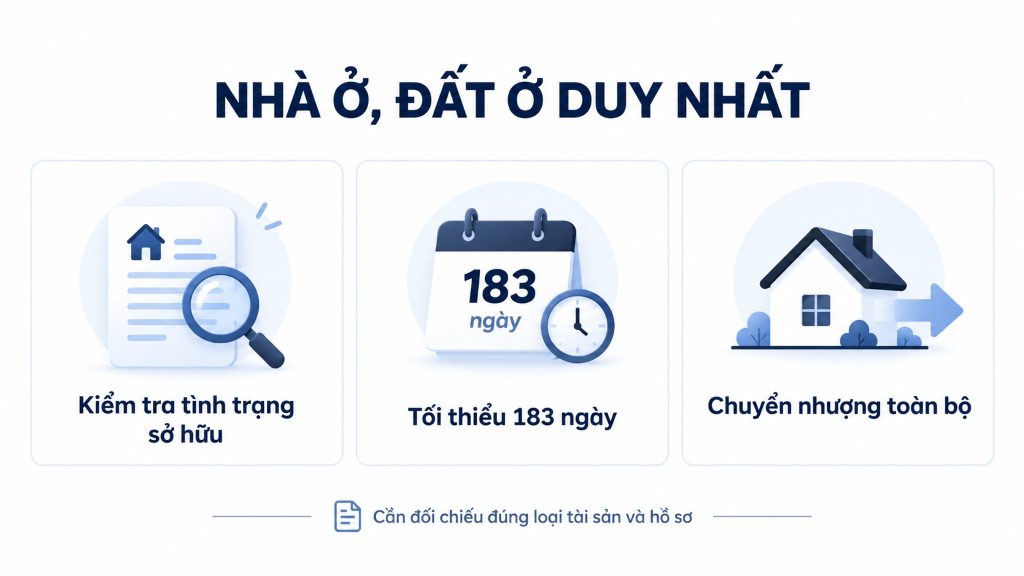
It is necessary to simultaneously check the ownership status, the minimum duration of 183 days, and the entire transfer; specific dossiers must also meet related regulations.
Co-ownership and shared marital property are considered separately for each person
The real estate transfer tax for co-owned properties is determined separately for each person based on the ownership ratio and legal documents. Exemption conditions under the sole property category are also considered individually, not automatically applied jointly to everyone on the title.
For example, a husband and wife jointly transfer a house; the husband has another residential house, while the wife does not have a house or land elsewhere. In this case, the income portion and conditions of each person must be evaluated separately. One cannot conclude that both must pay tax just because the husband has separate property, or that both are exempt.
The real estate transfer tax dossier therefore needs to clarify shared property, separate property, and the ownership ratio. Having only one person recorded as the representative submitting the dossier does not remove the declaration obligation of the involved subjects.
Property division upon divorce and cases not to be confused
Regarding the real estate transfer tax, income from dividing real estate upon divorce by agreement or court ruling falls under the exemption category as prescribed. However, if one person subsequently sells the property to a third party, this sale transaction must be evaluated according to the basis applicable to that specific transaction.
It should also not be inferred that land previously exempted or reduced from land use fees will always be exempt from real estate transfer tax in subsequent sales. Similarly, exemptions for converting agricultural land to rationalize production is a specific case, not meaning all agricultural land sale transactions are exempt.
Who pays the real estate transfer tax and when is the obligation determined?
The person earning income from the transfer is the subject that needs to determine the tax obligation. The parties can agree that the buyer pays on their behalf, but that does not turn the real estate transfer tax into a separate tax levied on buying a house.
According to guiding regulations, if the contract does not agree that the buyer pays the tax on behalf of the seller, the time to determine the taxable income is when the transfer contract takes effect. If there is an agreement for the buyer to pay on behalf, the time is determined when carrying out the procedures for registering the property use rights and ownership rights.
For the real estate transfer tax, the tax calculation time needs to be distinguished from the dossier submission deadline and payment deadline according to tax management procedures. Transactions involving future-formed elements or dossiers arising across multiple periods must cross-reference separate regulations; do not just rely on the deposit date to decide how to apply them.
In the contract, it should clearly state who prepares the dossier, who pays on behalf, the source of tax payment funds, and how to hand over the receipts. A transparent agreement helps limit arguments about what financial obligations are already included in the selling price.
Dossier for calculation and request for real estate transfer tax exemption
Preparing the real estate transfer tax dossier should go alongside reviewing the title transfer dossier. The specific components depend on the property type, transaction form, exemption grounds, and submission method announced by the competent authority.
- Property documents: Certificate and documents related to the land use rights, house, or construction works ownership being transferred.
- Transaction documents: contract or document suitable to the transfer form, along with information on price and agreement to fulfill financial obligations.
- Obligated person’s information: identification papers, tax information, co-ownership status, and representation or authorization documents if any.
- Applicable declaration form: use the forms and declaration methods currently in effect, ensuring consistent information with the registration of changes dossier.
- Exemption request documents: papers proving family relationships or documents and declaration content meeting the requested exemption case.
If you need support preparing real estate transfer tax dossiers and related procedures, you can refer to the land registration and title transfer services of N.N SERVICES. The support scope should be agreed upon based on the actual dossier, including reviewing, declaring, acting as an authorized representative, and service fees.
Transacting parties should keep the submitted real estate transfer tax dossier, the financial obligation notice, and payment receipts. If requested to supplement, correctly cross-reference the missing content instead of changing information between declarations without clarifying the grounds.

Illustrative photo: Consistently preparing the tax dossier and the registration of changes dossier helps the procedure coordination process be clearer.
Notes when budgeting for real estate buying and selling costs in Ho Chi Minh City
When budgeting, separate the property price, real estate transfer tax, and each related cost. Even if exempt from personal income tax, registration fees, notarization, and other payable charges must still be considered separately; do not understand that being exempt from one tax means the transaction has zero title transfer costs.
Another point is distinguishing between buying directly from a developer and receiving a transfer from an individual. When referencing the Gladia Heights project in Ho Chi Minh City distributed by N.N REALTY, buyers need to determine the product type and the contracting party. Do not manually apply the 2% personal income tax formula to the entire tax obligations of the developer enterprise.
For secondary transactions, the real estate transfer tax should be clarified before finalizing the amount the seller actually receives. For the same agreed price, the allocation of obligations and costs can lead to different amounts each party needs to prepare. These contents should be clearly stated in the transaction agreement.
Frequently asked questions about real estate transfer tax
Conclusion: determine the correct obligations before closing the deal
Real estate transfer tax from July 1, 2026, continues to need to be understood through three elements: the correct subject, the correct price as a basis, and the correct exemption conditions. The 2% rate is an important formula, but it does not replace checking the dossier of each transferor.
For transactions in Ho Chi Minh City, clarifying the real estate transfer tax right from the preparation phase will help the parties budget and coordinate procedures better. You can contact N.N GROUP to discuss your transaction needs and connect with the appropriate department within the N.N REALTY, N.N SERVICES systems.