
2026 Investment Law: Tax Incentives for High-Tech Projects in Ho Chi Minh City
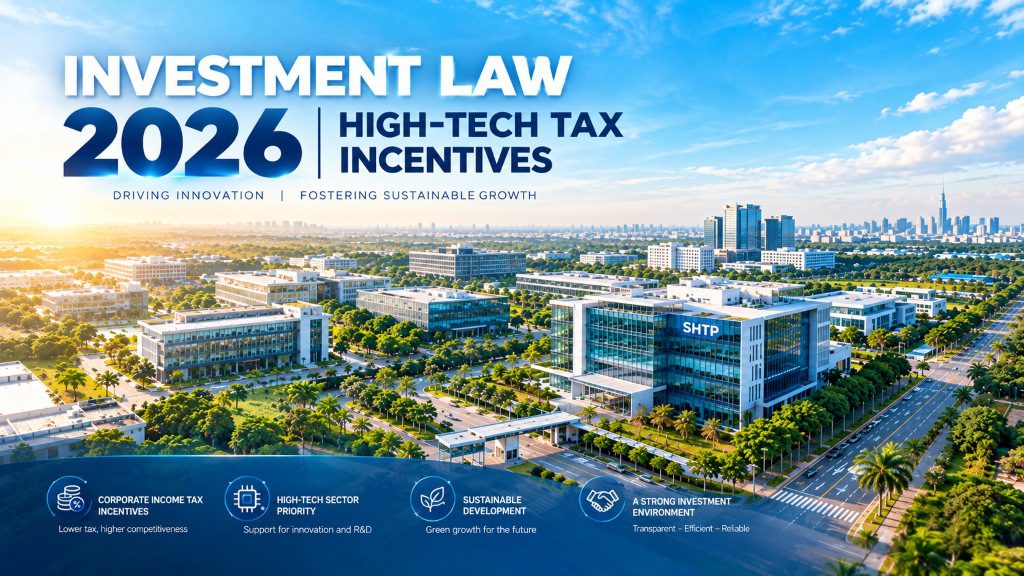
Entering the pivotal phase of a new economic cycle, Vietnam is witnessing a historic transformation in its strategy to attract foreign direct investment (FDI).
No longer stopping at the advantage of cheap labor or resource exploitation, the economy’s focus is shifting strongly towards innovation, technology transfer, and sustainable development (ESG). In that context, the Investment Law 2026 emerged as a breakthrough legal framework, establishing a more transparent and attractive new set of rules, especially for high-tech projects in HCMC.
Ho Chi Minh City, with its position as the most dynamic economic and financial megacity in the country, is pioneering in actualizing policies from the Investment Law 2026. Pouring capital to invest in HCMC into fields such as semiconductor microchips, artificial intelligence (AI), Big Data, or biotechnology not only helps businesses access a massive intellectual workforce but also opens up opportunities to enjoy unprecedented high-tech project tax incentives.
However, to meet the strict criteria of the law and truly leverage these financial levers, investors need extremely thorough preparation.
The in-depth article below will comprehensively dissect the latest regulations of the Investment Law 2026, analyze in detail the necessary and sufficient conditions, and outline a roadmap to optimize high-tech project tax incentives specifically for FDI enterprises with ambitions to establish R&D centers and manufacturing plants for high-tech projects in HCMC.
Macro expert’s perspective: The introduction of the Investment Law 2026 does not stand alone but is part of a synchronized legal ecosystem along with the new Land Law and Real Estate Business Law. This resonance completely resolves bottlenecks in site clearance, land allocation, and tax refund mechanisms, creating an extremely smooth “runway” for international tech “eagles” to land safely in the Southern region.
Macroeconomic context: Why is HCMC the “capital” of high-tech projects?
Before delving into the provisions of the Investment Law 2026, we need to understand clearly why the strategy of investing in HCMC is always the number one priority for billion-dollar tech corporations (Tech Giants). According to statistical reports from the Government Web Portal, FDI inflows are clearly differentiating. While labor-intensive processing projects tend to shift to suburban provinces, the core area of HCMC (especially Thu Duc City) is focusing on positioning itself as the R&D (Research and Development) center of the entire Southeast Asian region.
Infrastructure is the core foundation of technology. HCMC possesses a leading-scale Hi-Tech Park (SHTP) in the region, which has successfully gathered “giants” such as Intel, Samsung, and Nidec. Furthermore, the completion of Metro Line 1 (Ben Thanh – Suoi Tien) directly connecting the District 1 financial center with the National University Village and the Hi-Tech Park has created a perfect TOD (Transit Oriented Development) ecosystem.
This helps high-tech projects in HCMC easily attract and retain high-quality human resources – Vietnam’s top engineers and programmers.
Besides, the Investment Law 2026 pays special attention to creating a competitive advantage for HCMC through specific mechanisms. Investing in HCMC is not just about building a factory, but planting a strategic flag to tap into a domestic consumer market of more than 100 million people that is digitizing at breakneck speed, and at the same time using this as an export springboard thanks to the Cat Lai – Cai Mep deep-water seaport system that is being continuously expanded.

Advanced R&D and workspace in the Eastern area of HCMC, meeting the standards of the 2026 Investment Law.
Decoding the 2026 Investment Law: Conditions for recognizing high-tech projects
The Government’s generosity in high-tech project tax incentives is proportional to extremely strict requirements. The Investment Law 2026 has quantified the criteria, preventing businesses from “disguising” as high-tech to benefit from the state budget. For an FDI project to be granted a certificate as a high-tech project in HCMC, the business must pass a comprehensive filter.
First of all, the project’s products must be on the List of high-tech products encouraged for development issued by the Prime Minister. This includes but is not limited to: Semiconductor microchips, aerospace components, industrial robots, applied AI software, and green energy solutions (Hydrogen, offshore wind power). However, merely manufacturing products on the list is not enough; the Investment Law 2026 also imposes extremely specific financial and personnel quotas.
For visualization, below is a table comparing and analyzing the core conditions that businesses must continuously maintain throughout the project life cycle to avoid having their incentive licenses revoked:
| Key evaluation criteria | Mandatory requirements (Medium and large enterprise scale) |
|---|---|
| 1. High-tech revenue ratio | Revenue from high-tech products must reach at least 70% of the total annual net revenue of the entire project. |
| 2. Research & Development (R&D) costs | Total costs for R&D activities conducted in Vietnam must reach a minimum of 1% to 2% (depending on capital scale) of total net revenue minus input value. |
| 3. High-level personnel | The number of employees with a College/University degree or higher directly participating in R&D must reach at least 2.5% to 5% of the total workforce, depending on land and capital usage scale. |
| 4. Environmental standards (ESG) | Apply international quality management systems (ISO 9001, ISO 14001). Carbon emission intensity (Carbon footprint) must be 20% lower than the industry average. |
As can be seen, the Investment Law 2026 does not encourage “processing and assembly”. Vietnam’s ultimate goal is to require corporations to transfer technology, master the supply chain, and train human resources. Proving the R&D cost ratio in Vietnam is often the most difficult bottleneck for corporations when applying for high-tech project tax incentives, requiring an extremely clear accounting and cost allocation system right from the first financial year.
The big picture of high-tech project tax incentives
Once successfully meeting the strict conditions mentioned above, the reward for the business is the most “massive” high-tech project tax incentive package in Vietnam’s economic legal history. The Investment Law 2026 designs these incentive policies not only to minimize start-up costs but also to directly increase the Net Profit Margin for shareholders during the first 15 years of operation.
The biggest incentive policy lies in Corporate Income Tax (CIT). While the current standard tax rate is 20%, high-tech projects in HCMC are subject to a special preferential tax rate of 10% for 15 years, starting from the first year the project generates revenue. Even better, the business is fully tax-exempt for the first 4 years (starting from the year of taxable income), and receives a 50% reduction in tax payable for the next 9 years (meaning only 5% CIT has to be paid during these 9 years).
Besides income tax, the incentive system of the Investment Law 2026 also broadly covers many other taxes and costs, creating a solid financial shield for FDI flows:
| Tax / Cost Type | Incentive & Exemption Policy | Eligibility Conditions & Notes |
|---|---|---|
| Import Tax | Exemption from import tax for machinery, equipment, components, and specialized materials forming fixed assets that cannot yet be produced domestically. | Must prepare a List of duty-free goods and submit it to customs before importing the first shipment. |
| VAT | 0% tax rate for exported high-tech products. The input VAT refund mechanism is prioritized for quick processing. | Conduct transactions via banks, have a valid set of customs documents and export contracts. |
| Land & Water Surface Rent | Exemption from land rent during the basic construction period (maximum 3 years). After that, exemption from land rent for the next 11 to 15 years. | Especially strongly applied when investing in the Saigon Hi-Tech Park (SHTP) in Thu Duc City. |
Tax risk management warning: These incentives are not a “lifetime warranty ticket”. Under the 2026 Investment Law, the Tax Authority and the Ministry of Science & Technology will conduct periodic inspections (post-audits). If the business fails to maintain the R&D cost ratio or the high-quality personnel ratio, the project will be stripped of its high-tech title, and simultaneously face clawbacks on all exempted taxes plus late payment penalties. This is why the Internal Audit system plays a vital role.
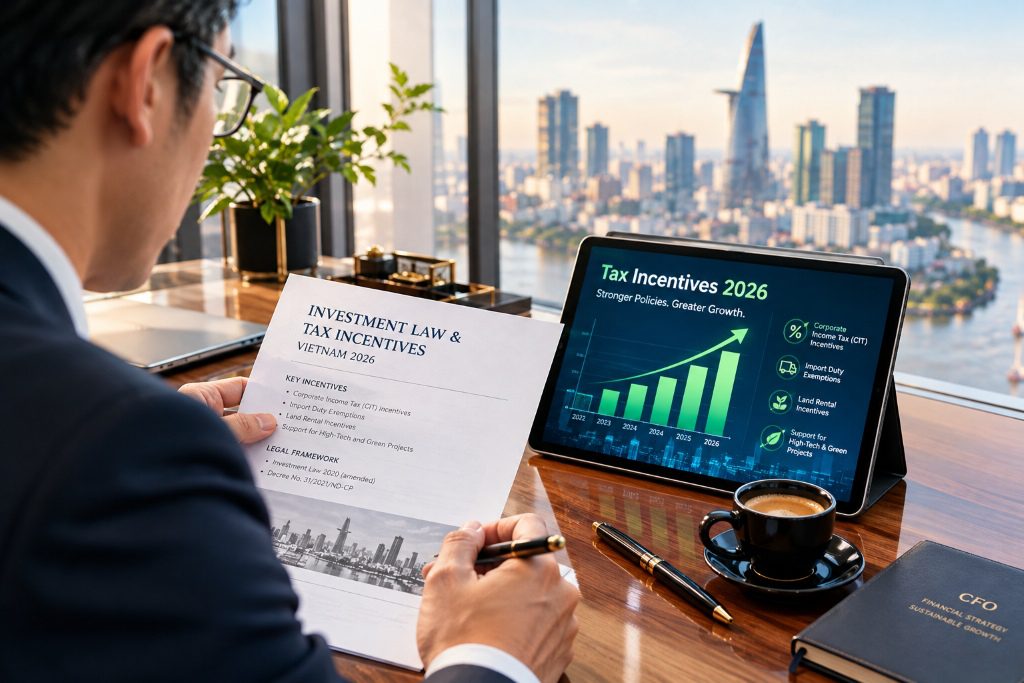
FDI enterprises need a clear financial strategy to maximize tax incentives in the context of the Global Minimum Tax.
Global Minimum Tax (GMT) and Vietnam’s strategic countermeasures
It would be a huge omission to analyze high-tech project tax incentives while ignoring the presence of the Global Minimum Tax (GMT) under Pillar 2 of the BEPS framework initiated by the OECD. Fully applied in 2026, the GMT stipulates that multinational companies with consolidated global revenues of EUR 750 million or more will be subject to a minimum tax rate of 15%, regardless of where they operate.
This poses a tough problem: If the Investment Law 2026 incentivizes high-tech projects in HCMC with a tax rate of 5% or 10%, the country where the parent corporation is headquartered (e.g., South Korea, US, Japan) will collect the difference (top-up tax) to reach 15%. Inadvertently, Vietnam’s monetary tax incentives will be neutralized, and investment capital flows will not feel the actual benefits.
To completely resolve this bottleneck, the Vietnamese Government has issued a Qualified Domestic Minimum Top-up Tax (QDMTT) mechanism to retain this tax difference in Vietnam. More importantly, the Investment Law 2026 has codified the establishment of the “Investment Support Fund” drawn from this very GMT revenue source.
Instead of offering incentives by reducing CIT (which violates the 15% rule), Vietnam is shifting towards direct financial support (Cash Grants) for high-tech projects in HCMC by funding part of the R&D costs, human resource training costs, fixed asset investment costs, or supporting social infrastructure for workers.
The strategic transition from “Tax Exemption” to “Cash Support” proves the acumen of the 2026 Investment Law, ensuring Vietnam remains the most competitive destination in the region in the Global Minimum Tax era.
Commercial real estate and Infrastructure for high-tech projects
Planning the strategy for investing in HCMC does not just stop at legal and financial aspects, but is also closely related to finding a perfect physical space. High-tech projects in HCMC often take two popular forms: R&D complexes (usually Grade A offices) and Smart manufacturing complexes (factories).
For corporations specializing in software, chip design (Fabless), and data centers, the choice of workspace prioritizes office buildings with green certificates (LEED, Lotus) in the central area of District 1 or Thu Thiem New Urban Area.
These spaces not only accommodate massive telecommunications infrastructure but also act as a magnet to attract top experts. Here, advice from high-end commercial real estate brokerage experts of N.N REALTY will help businesses access planning maps, vacancy rates, and negotiate lease contracts with long-term strategic value.
On the other hand, for businesses needing to install hardware and microchip production lines, the Saigon Hi-Tech Park (SHTP) in Thu Duc City is the “holy land”. However, the land fund at SHTP is increasingly scarce. Applying for an in-principle investment approval and land allocation here requires the project to have extremely outstanding technological content and a strong spillover effect on the domestic supporting enterprise ecosystem.
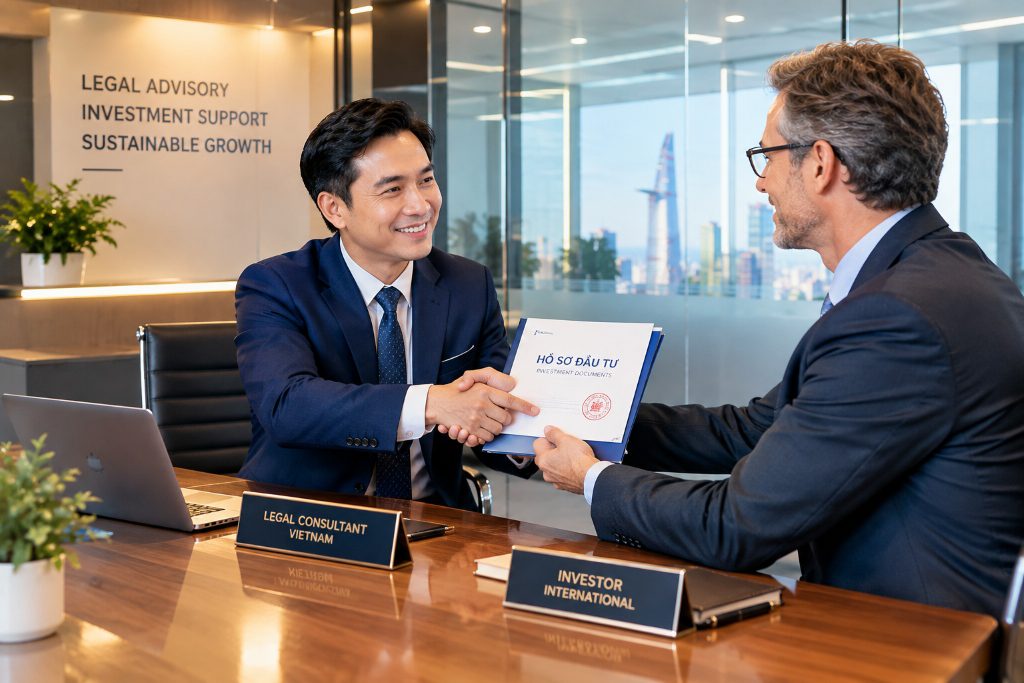
The companionship of local legal experts helps businesses apply for investment licenses quickly and safely.
Procedural process for establishing high-tech FDI enterprises
The path to expanding business and actualizing a high-tech project in HCMC requires investors to navigate a complex administrative procedure maze. Based on the 2026 Investment Law and the latest Enterprise Law, the basic roadmap includes 3 vital milestones:
- Stage 1 – Applying for an Investment Registration Certificate (IRC): This is the most difficult step. The business must submit an Investment Project Proposal dossier (including reports on financial capacity, technology, and environmental impact assessment). For high-tech projects, the dossier will be cross-appraised by the Department of Planning and Investment, the Department of Science & Technology, and the Hi-Tech Park Management Board (if located in SHTP).
- Stage 2 – Applying for an Enterprise Registration Certificate (ERC): After having the IRC, applying for the ERC (equivalent to a company establishment license) will happen more quickly, usually within 3-5 working days. At this point, the FDI legal entity status in Vietnam is officially established.
- Stage 3 – Registering for High-Tech Enterprise certification: This is an independent procedure to finalize the entitlement to high-tech project tax incentives. The business submits a dossier to the Ministry of Science and Technology (or an authorized agency) to defend its R&D and personnel indicators.
Any error in declaring industry codes (VSIC), proving finances, or explaining technology can cause the project to be rejected or delayed for years. That is why 100% of international corporations when investing in HCMC delegate this process to local legal consulting organizations.
Through the FDI business establishment, accounting, and auditing services system of N.N SERVICE, investors will be designed a safe legal roadmap, completely eliminating “sub-license” risks and shortening the project start-up time by 60%.
Frequently Asked Questions (FAQ)
During the legal and real estate consulting process for hundreds of FDI enterprises investing in HCMC, we have compiled the 6 most crucial questions related to the Investment Law 2026 and high-tech project tax incentive policies:
1. If my company specializes in assembling electronic components (without R&D), can it be recognized as a high-tech project?
According to the Investment Law 2026, merely importing components for assembly will NOT be recognized as a high-tech project. You are required to maintain an R&D budget in Vietnam of 1-2% of total revenue and have a technology transfer process to be eligible for tax incentives.
2. Are high-tech projects in HCMC owned by foreign investors limited by a capital contribution ratio (Foreign ownership limit)?
Most areas of software production, microchips, AI, and high-tech R&D allow foreign investors to own 100% of charter capital. You are not required to enter into a joint venture with a Vietnamese partner unless the project integrates services such as network telecommunications or certain conditional business lines according to WTO commitments.
3. From what point is the policy of 4-year tax exemption and 50% reduction for the next 9 years calculated?
The CIT exemption/reduction period is calculated from the first year the project has taxable income (makes a profit). However, if after 3 years from the year of generating revenue, the project still reports a loss, the tax exemption/reduction period will automatically trigger starting from the 4th year.
4. When affected by the Global Minimum Tax (15%), will my business be compensated?
Vietnam has established an “Investment Support Fund”. Although you may have to pay the tax difference (top-up tax) to reach 15%, you can apply for direct cash funding from this Fund for R&D activities, human resource training, or purchasing high-tech fixed assets, helping to offset the cash flow.
5. How long does the procedure to apply for an Investment Registration Certificate (IRC) for a high-tech project in SHTP take?
Because this is a key project group requiring strict technology appraisal, the normal IRC application process takes 30 to 45 working days (from the submission of a complete valid dossier). Preparing an accurate Technology Capacity Explanation from the beginning is the decisive factor for licensing speed.
6. How to lease land in the Saigon Hi-Tech Park (SHTP)?
The land fund at SHTP is currently very scarce and subject to strict approval. You must submit an investment registration dossier clearly presenting the capital scale (usually prioritizing large capital projects), technological content, and training commitments. The land lease term is typically 50 years, accompanied by ground rent exemption/reduction policies according to current regulations.
Conclusion: Actualizing investment ambitions with the N.N GROUP ecosystem
The promulgation of the Investment Law 2026 along with a series of high-tech project tax incentives is creating a powerful attraction, making investing in HCMC an unmissable strategic move for multinational corporations. However, the journey from conceptualizing on the drawing board to operating a multi-million-dollar FDI project is a path full of challenges regarding the complexity of administrative procedures, real estate information barriers, and strict tax sanctions.
To ensure absolute success and eliminate all risks when stepping into the Vietnamese market, the companionship of a reputable local partner who understands the rules of the game is a prerequisite. The N.N GROUP ecosystem proudly brings the most outstanding “All-in-One” B2B solution suite for your business:
- Starting with N.N REALTY: Our team of commercial real estate brokerage experts will provide you with exclusive market data, directly represent the business in negotiations, find elite industrial land funds at SHTP, or ESG-standard Grade A office spaces in the center of HCMC, creating the most solid physical foundation.
- Accompanying throughout with N.N SERVICE: We act as your legal architect, covering a full package from applying for Investment Certificates (IRC, ERC), high-tech dossier appraisal, to establishing an accurate Accounting – Tax structure so the business can 100% optimize incentive cash flows without getting caught in any post-audit barriers.
Don’t let legal ambiguity or choosing the wrong premises disrupt your global supply chain development pace. Let the N.N GROUP ecosystem become the most solid launchpad, creating success for your high-tech project in HCMC today!