


HCMC TOD Planning 2026–2027: Metro and Notable Areas
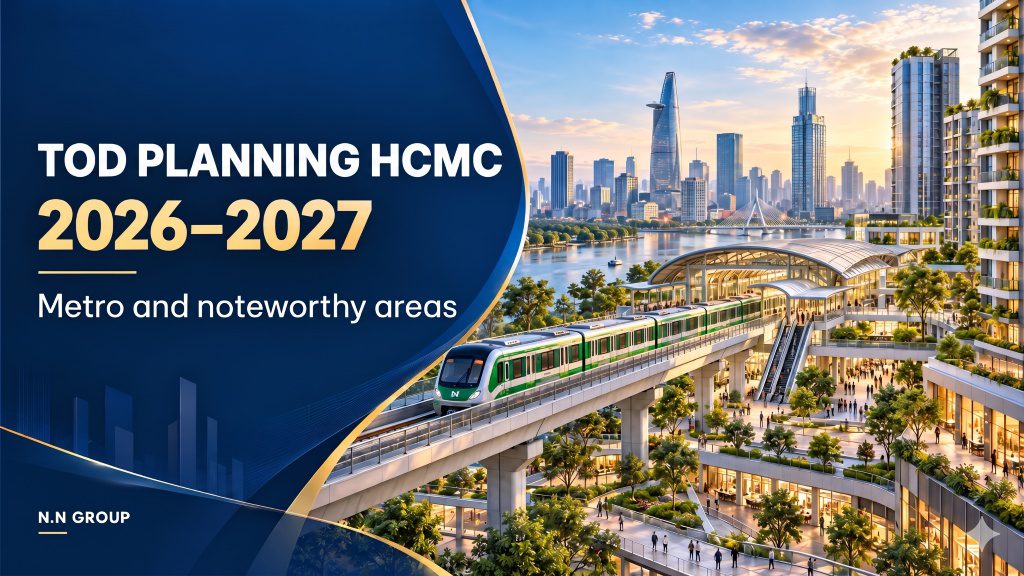
HCMC TOD Urban Planning for the 2026–2027 period is attracting significant attention as the city gradually connects urban development with the metro network. For homebuyers, property owners, and businesses, what matters most is not just being near a station. The more practical question is which areas already have planning foundations, what milestones are still expected, and how public transport accessibility will improve living, commuting, and business operations.
Properly tracking HCMC TOD planning helps identify opportunities tied to actual usage needs. This article focuses on the metro corridors and hubs within the city, while clarifying what needs to be checked before choosing real estate around a station.
Information cross-checked as of October 25, 2026. The approval schedules in this article are recorded according to announced plans and should not be construed as completed results. HCMC TOD planning must be distinguished from the construction progress of metro lines and the legal dossiers of individual properties.
What is HCMC TOD Urban Planning and Why is it Worth Attention?
TOD refers to Transit-Oriented Development. Stations become convergence points connecting residences, employment, commerce, services, and public spaces. The effectiveness of this model depends on how these activities are organized within an easily accessible area.
Therefore, HCMC TOD planning does not just revolve around building high-rises alongside railway lines. A neighborhood featuring continuous pedestrian pathways, safe pedestrian crossings, connecting buses, and suitable amenities can deliver a far better user experience than a location that is simply close to tracks on a map.
For real estate, advantages can emerge when users save commuting time or gain enhanced access to jobs, customers, and services. However, the impact of HCMC TOD planning must be evaluated individually for each location, rather than assuming all properties in the area benefit equally.
 Illustration of urban organization principles around metro stations; not an approved planning project.
Highlights of HCMC TOD Planning as of October 2026
The policy framework to update is Resolution 56/2026/NQ-HĐND in the HCMC Official Gazette, issued on September 22, 2026, taking effect from October 1, 2026, replacing Resolution 21/2026/NQ-HĐND. When researching HCMC TOD planning, three key contents must be carefully reviewed:
- Boundary scope: Maximum 1,000 m from the conventional center of stations and depots; specific boundaries are considered based on actual conditions.
- Floor area ratio (FAR) / Land use coefficient: The combined aggregate coefficient for mixed-use, commercial-service, and residential functional plots can be increased by a maximum of 1.5 times compared to standard regulations.
- Development conditions: Scale must align with the capacity of technical and social infrastructure.
These regulations do not mean every home is automatically granted a 50% increase in floors. Under HCMC TOD planning, property owners must still cross-reference boundaries, functions, and approved targets for their specific location.
HCMC TOD Planning Milestones to Monitor in 2026–2027
According to TOD implementation information published by the HCMC Portal on September 25, 2026, various areas are at different preparation stages. The table below summarizes the announced tentative schedules; it does not confirm that procedures have been completed at the time of reading.
| Area | Announced Basis | Tentative Milestone |
|---|---|---|
| Metro Line 2: Ben Thanh – Tham Luong | Boundaries approved under Decision 3651/QĐ-UBND dated June 19, 2026. | Submit for appraisal and planning approval in December 2026. |
| Thu Thiem Station | Boundaries approved under Decision 3845/QĐ-UBND dated June 26, 2026. | Appraisal and approval from December 2026 to January 2027. |
| Metro Line 1: Ben Thanh – Suoi Tien | According to September information, boundary consultations are underway; boundary submission expected in October 2026. | Planning approval in Q1–Q2/2027. |
| Binh Khanh Station; Tham Luong – Cu Chi | Expected boundary review report completion in Q4/2026. | Planning approval in Q1–Q3/2027. |
| Ben Thanh – Can Gio | Boundaries currently under review per published information. | TOD planning formulation and approval expected in Q1–Q3/2027. |
Regarding HCMC TOD planning, the planning approval milestone and the facility operation timeline are two different pieces of information. Observers should note both the plan announcement date and subsequent update documents, avoiding using tentative schedules as handover commitments.
Notable Areas Around Metro Lines
Metro Line 1 Corridor: Observing Current Connection Quality in Operation
With the Ben Thanh – Suoi Tien corridor, the advantage when researching HCMC TOD planning is the ability to survey an operating metro line. Homebuyers and renters have the opportunity to test actual commuting journeys rather than relying solely on renderings or advertised distances.
Areas such as Thao Dien – An Phu, Rach Chiec, Phuoc Long – Binh Thai, and the Suoi Tien area deserve to be included in survey lists based on needs. These are suggestions for analyzing locations along the line, not a list of approved TOD projects.
When evaluating HCMC TOD planning here, one should measure the time from the doorstep to the exact station entrance, check connecting bus routes, and assess walking distances after disembarking. A journey requiring multiple transfers can differ significantly from the perception of being “close to the metro.”
For business spaces, customer traffic flow matters more than storefronts facing the railway line. It is necessary to observe whether station commuters pass by the storefront, whether there are suitable drop-off/pick-up spots, and whether the intended business operations meet local area demands.
 Diagram illustrating area groups analyzed in the article; not used to determine specific locations or planning boundaries.
HCMC TOD Planning Along Metro Line 2: Five Notable Area Groups
HCMC TOD planning along the Ben Thanh – Tham Luong section is notable for its scale of nearly 940 hectares, summarized into five area groups. Line scope and progress reading can be cross-referenced in the article Metro Line 2 HCMC by N.N GROUP.
| Area Group | Announced Scope | Approximate Area |
|---|---|---|
| Ben Thanh – Tao Dan | Area around Ben Thanh and Tao Dan stations. | 188.6 ha |
| Dan Chu – Bay Hien | Dan Chu, Hoa Hung, Le Thi Rieng, Pham Van Hai, Bay Hien. | 265 ha |
| Nguyen Hong Dao | Area surrounding Nguyen Hong Dao station. | 43.8 ha |
| Ba Queo – Tay Thanh | Ba Queo, Pham Van Bach, and Tay Thanh area. | 149 ha |
| Tham Luong Station and Depot | Tham Luong station and technical facility area. | 292.8 ha |
The above areas reflect research scopes according to published information, not the entirety of land funds available for sale or immediate new project deployment. In HCMC TOD planning, planning establishment boundaries must be distinguished from project boundaries, land recovery boundaries, and construction targets.
The Cach Mang Thang Tam – Truong Chinh corridor features vibrant existing residential and commercial activities. When surveying HCMC TOD planning here, one must consider both long-term urban renewal potential and site access impacts during construction. Property owners should monitor building entrances, traffic organization, and customer retention capacity.
Thu Thiem Station: Noting the Hub Role and Next Approval Steps
Thu Thiem station is a vital hub to monitor in HCMC TOD planning. However, the station area, the Thu Thiem urban scope, and individual real estate projects bearing the Thu Thiem name do not inherently share identical boundaries or legal statuses.
An appropriate approach is to determine where the introduced property is located relative to planning establishment boundaries and expected access networks. Afterward, verify connectivity to workplaces, services, and existing transport routes.
Regarding HCMC TOD planning around this hub, transit advantages must be translated into specific journeys. The designation “near Thu Thiem station” is insufficient to conclude travel times, operational conditions, or the convenience level of individual products.
For buyers interested in housing in the East, Gladia Heights on Vo Chi Cong, Binh Trung is a project distributed by N.N REALTY that can be included in comparison lists. When correlating with HCMC TOD planning, one should evaluate project location, commuting routes to workplaces, and accessibility to transport hubs via actual travel paths.
Tham Luong – Cu Chi, Binh Khanh, and the Can Gio Direction
These areas broaden the perspective on HCMC TOD planning beyond station points within the existing urban core. Nevertheless, they must be placed in their correct preparation stages according to published plans, avoiding viewing a connectivity orientation as an urban area with fully completed implementation conditions.
When surveying, one should start with existing needs: population, employment, services, and access transportation. A location is only suitable if a newly completed line meets expectations, involving higher dependence on progress. HCMC TOD planning must therefore be read alongside asset utilization capabilities during the waiting period.
Which Properties Can HCMC TOD Planning Create Advantages For?
The advantages of public transport only hold meaning when they suit users. Real-home apartments require convenient commuting; rental properties must fit target tenant groups; commercial spaces need customer flows capable of utilizing services. Reading HCMC TOD planning according to specific needs will make comparisons much clearer.
| Usage Need | Potential Advantages | Data to Verify |
|---|---|---|
| Buying Home for Living | More options for commuting, studying, and accessing services. | Actual journeys, operating hours, travel and living costs. |
| Rental Exploitation | Access to tenants interested in public transport connectivity. | Actual rental prices, vacancy rates, operating fees, and local demand. |
| Service Business | Potential access to additional customers along station pathways. | Foot traffic flows, stop/parking points, industries, and customer retention capacity. |
| Existing Land/Property Ownership | Opportunities to improve access and urban environment. | Planning boundaries, applied targets, and asset access conditions. |
HCMC TOD planning also sets forth the requirement to examine total ownership costs.
In the Southern region, buyers can explore Arcadia at Lavila on Nguyen Huu Tho axis, Nha Be and Vlasta Premier Phu Thuan on Dao Tri street, currently available in N.N REALTY’s distribution portfolio. These are options to cross-reference apartment functions, amenities, ownership costs, and living connectivity. Reviewing HCMC TOD planning must go hand in hand with current residential usability and the degree of dependence on future transport infrastructure.
Two properties with identical travel times to a station can still differ in management fees, construction quality, parking spaces, or accessibility for elderly residents. These differences directly affect living experiences and tenant retention capacity.
When researching HCMC TOD planning for business purposes, one should survey across various time frames and observe actual demand types. High pedestrian traffic does not automatically mean revenue suitable for all retail sectors. Exploitation value must be verified through operational plans and premises data.
How to Inspect Real Estate According to HCMC TOD Planning
A clear survey process helps avoid confusion between media information and property usage conditions. When applying HCMC TOD planning to a specific choice, attention can be focused on the following inspection groups:
- Accurately identify the property: Record the location, plot number, map sheet number, and identification information on records. Do not use project commercial names or area names to infer that a property belongs to TOD boundaries.
- Cross-check maps correctly: Review the issuance date, scope, and type of dossier provided. A circled image online must be verified against substantiated documents and planning information from competent authorities.
- Test commuting journeys: Start from the property’s doorstep to the exact station entrance; observe sidewalks, intersections, detours, and travel conditions during rain. If transfers are required, factor in waiting times.
- Survey local demand: Learn about residents, workers, tenants, or customers of the prospective business sector. Inquire about actual transactions and contracts rather than merely aggregating listing prices.
- Calculate financial plans: Outline purchase, renovation, operating, and vacancy costs according to personal capacity. Separate already usable benefits from anticipated expectations relying on future infrastructure.
- Monitor changes: Save survey dates, map sources, and checked documents. When new documents appear, re-verify before making decisions, especially for properties heavily marketed based on planning.
With HCMC TOD planning, a clear answer regarding boundaries and usage journeys is often much more valuable than general remarks about “catching the wave.” If correct property information cannot be ascertained, further verification should be conducted instead of filling gaps with market expectations.
 Illustration: Surveying actual journeys to station entrances helps evaluate the convenience level of each property.
Misunderstandings That Easily Distort TOD Evaluations
A common misconception when reading HCMC TOD planning is lumping all preparation steps into an “already deployed” status. The appearance of an area name in plans does not indicate when a specific property can change its function or be incorporated into a project.
Another misconception is taking asking prices as evidence of TOD effectiveness. Listing prices may reflect sellers’ expectations. To assess how HCMC TOD planning impacts a location, one must compare similar properties and examine usage demand, actual rental income, and associated costs.
The transition period of HCMC TOD planning must also be factored in. Construction, changes in access routes, or adjustments to exploitation plans can affect daily living and business before long-term benefits materialize. A suitable choice should be capable of meeting current needs while retaining room for adaptation.
Frequently Asked Questions About HCMC TOD Planning
Conclusion: Monitor Planning, Choose Based on Actual Needs
HCMC TOD planning for the 2026–2027 period opens up a more specific perspective on the relationship between metros and urban development. Corridors such as Metro Line 1, Metro Line 2, the Thu Thiem hub, and preparing connectivity directions must all be monitored according to their actual dossier status.
The value of HCMC TOD planning lies in its ability to create a more convenient environment for living, working, and utilizing services. When considering properties, start with planning boundaries, actual journeys, and usage needs. You can contact N.N GROUP to discuss your needs, areas of interest, and criteria that need clarification before making a selection.