

Overview of the HCMC Logistics Market 2026: Demand for Smart Warehousing and the New Wave of FDI Investment
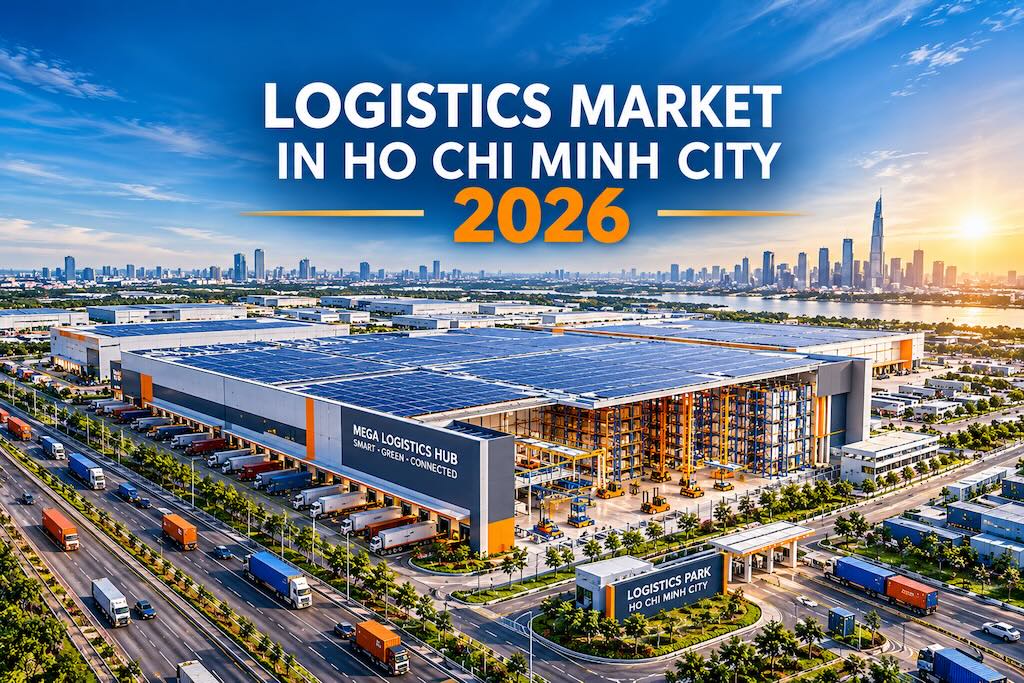
Entering 2026, the HCMC logistics market is witnessing a historic transformation, escaping the image of traditional labor-intensive warehouses to enter the era of comprehensive automation. The friction of macroeconomic factors: from the acceleration of cross-border e-commerce, the recovery of the global supply chain, to the landing of a new FDI wave, has turned the Southern key economic region into the most fiercely competitive “battlefield” of the logistics industry.
For multinational enterprises (MNEs) and industrial real estate investment funds, understanding the pulse of the HCMC logistics market is not just a problem of optimizing transportation costs. It is a survival problem to ensure the flow of goods is not disrupted. The boom in demand for smart warehousing is no longer a luxury competitive advantage, but has become the minimum standard to meet the same-day delivery expectations of modern consumers.
This in-depth article is designed as a macroeconomic lens, providing Supply Chain Managers, Chief Strategy Officers, and investors with a panoramic view of the HCMC logistics market. We will detail the shift in capital flows, the strict technical standards of smart warehousing, and outline the legal roadmap for businesses to successfully catch the new FDI wave in this highly potential logistics sector.
Macro analyst’s perspective: The severe scarcity of clean land funds in the inner-city area is creating massive pressure on the HCMC logistics market. To solve this problem, the development trend of multi-story warehouses integrating automated storage systems is holding absolute dominance. Investors who are late in updating technology and fail to meet smart warehousing needs will quickly be eliminated by the new FDI wave from global tech and retail giants.
Driving forces: E-commerce and the new FDI wave
To explain the boom in demand for smart warehousing, we need to look at two core growth drivers reshaping the structure of the HCMC logistics market. According to macro analysis reports from N.N GROUP, domestic purchasing power is breaking out strongly, leading to a radical change in the goods distribution model.
First, the dominance of E-commerce and Social Commerce. Consumers no longer accept a waiting time of 3-5 days. The pressure of processing tens of thousands of retail orders per day (Micro-fulfillment) during Mega Sales requires a logistics system with absolute precision. Traditional warehouses with manual picking processes completely collapse under this pressure, forcing businesses to hunt for smart warehousing solutions.
Second, the HCMC logistics market is receiving a new FDI wave with completely different quality. No longer simple assembly and processing workshops, current FDI capital focuses on high-value industries such as semiconductors, biopharmaceuticals (Biopharma), and high-tech electronics.
The goods of these industries are extremely sensitive to temperature, humidity, and shock. This requires the warehouse system to meet strict international standards like GSP (Good Storage Practice) or cleanroom environmental control systems, pushing the demand for smart warehousing to a new height.
Anatomy of the smart warehousing structure
A common mistake many investors make when entering the HCMC logistics market is confusing a modern warehouse with smart warehousing. A high, clean warehouse is not necessarily “smart”. Intelligence lies in the intersection between physical infrastructure and the control software ecosystem.
To meet the demands of the new FDI wave, a logistics space classified as A+ smart warehousing must fully converge the following core technical standards:
| Technical Evaluation Item | Standard requirements to cope with the new FDI wave |
|---|---|
| 1. Physical Automation (Robotics & AS/RS) | Possessing Automated Storage and Retrieval Systems (AS/RS), applying Automated Guided Vehicles (AGV) or Picking Robots. Static floor load must be from 3.0 tons/m2 upwards and floor flatness (Super Flat Floor) must reach F-min standards for risk-free robot operation. |
| 2. Core Management System (WMS & IoT) | The automated facility must be operated by a Warehouse Management System (WMS) integrating Artificial Intelligence (AI) to forecast storage demand. 100% of the space is covered by IoT (Internet of Things) to track the location and temperature of goods in real-time. |
| 3. Green Standards and Energy (ESG) | Mandatory possession of sustainable development certificates (LEED/Lotus). Rooftop Solar systems must supply at least 30% of operational energy, meeting the carbon emission reduction criteria of multinational corporations in the new FDI wave. |
| 4. Clear Height and Dock Levelers | Clear ceiling height from 10m to 14m to optimize multi-level storage space. The number of Loading Docks equipped with automatic Dock levelers is at a ratio of 1 door/500m2 of warehouse area, accommodating the fast-paced new FDI wave. |
The strictness of these standards makes the supply of A-class facilities in the HCMC logistics market always scarce, with occupancy rates frequently maintained above 95%. To avoid missing out on strategic locations, businesses should directly consult the industrial real estate database from N.N REALTY to pre-lease logistics spaces before the project finishes construction.
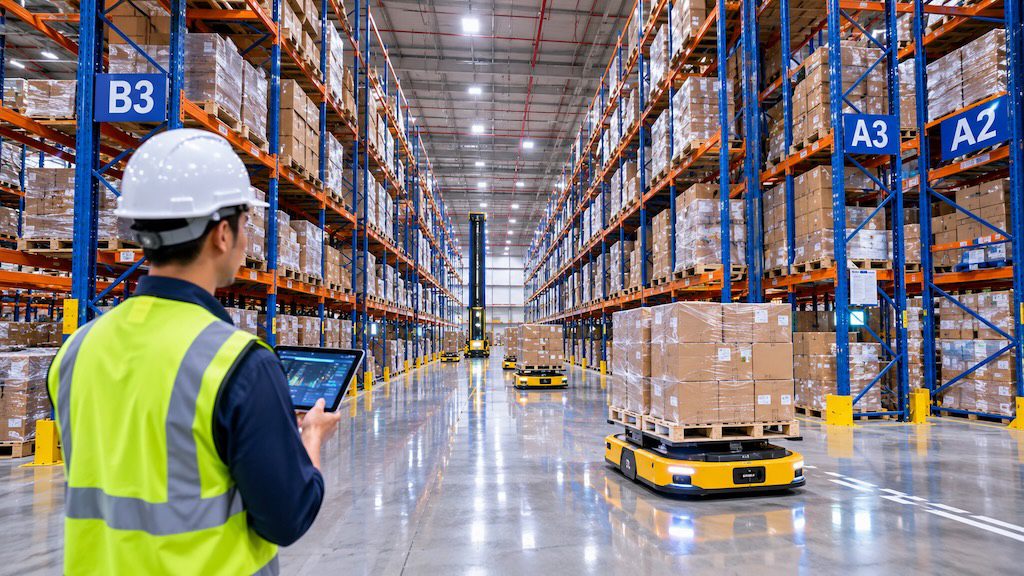
Technical standards inside a Class A smart warehousing facility serving the new FDI wave in the HCMC logistics market.
Spatial shift: Inner-city and suburban logistics
Under the pressure of high-tech storage demand and chronic traffic jams, the map of the HCMC logistics market is witnessing a clear Spatial Shift, polarizing into two distinct but closely complementary development models.
First, the Mega Logistics Hubs model shifting to suburban areas. Developers are leveraging the expressway network and Ring Road 3 planning to establish super warehouses in Binh Duong, Dong Nai, and Long An. This area acts as a Distribution Center, receiving raw materials from seaports and providing massive storage space serving the new FDI wave in the manufacturing sector.
Second, the Urban Logistics / In-city Warehouses model. This is an extremely crucial piece to solve the Last-mile delivery problem within inner HCMC. These facilities do not need overly large areas but must absolutely be smart warehousing, located right inside densely populated residential areas (like District 7, Thu Duc City). Restructuring old commercial premises into automated Micro-fulfillment centers is an investment trend bringing extremely high return rates for private equity funds.
Understanding the feng shui and energy shifts of newly planned areas through warehouse feng shui knowledge from N.N REALTY is also a unique factor helping Asian investors (Japan, Taiwan, Singapore) increase confidence when choosing a location for their general distribution warehouse.
Legal barriers: Investment licenses and Environment
The attractiveness of the HCMC logistics market is undeniable, but the capital injection path of the new FDI wave is not entirely rosy. Logistics is a conditional business line, governed by multiple intersecting legal codes. Establishing a smart warehousing project requires investors to navigate a maze of complex administrative procedures.
One of the biggest barriers for foreign investors is applying for the Investment Registration Certificate (IRC) for the objective of providing logistics services. FDI enterprises must prove financial capacity, operational experience, and especially comply with regulations on foreign ownership limits (Foreign room) in some narrow sub-sectors like cargo handling services or inland transportation.
The second challenge lies in construction and environmental legality. Modern automated projects, especially Cold Storage or chemical storage warehouses, consume massive amounts of energy and pose high fire and explosion risks. The appraisal process for the Environmental Impact Assessment (EIA) Report and applying for the Fire Prevention and Fighting (PCCC) Design Appraisal Certificate can drag on for months, stalling the entire project deployment plan (Capex).
To ensure FDI capital flows are disbursed on schedule, international corporations cannot “sweep for mines” in the legal system on their own. Using legal consulting and business establishment services of N.N SERVICE is the perfect insurance solution, helping businesses overcome all barriers from the IRC and EIA licensing steps until the warehouse officially goes into commercial operation.

N.N SERVICE legal expert consulting to untangle investment licensing (IRC) procedures for projects in the HCMC logistics market.
M&A Strategy: Shortcut to acquire market share
Facing the severe scarcity of clean land funds and prolonged legal waiting times, the new FDI wave is strategically shifting to Mergers and Acquisitions (M&A) to immediately capture market share in the HCMC logistics market. Instead of building from scratch (Greenfield), international investment funds hunt for “Brownfield” projects (currently operating) or land plots with 100% completed legal permits to acquire.
The top hunting targets today are cold storage projects or old factory complexes with the potential to be renovated into smart warehousing. These M&A deals not only help investors save 12 to 24 months of executing administrative procedures but also immediately inherit the existing customer base of the seller (Target company).
However, M&A deals in the industrial real estate sector harbor extremely large risks regarding taxes, hidden debts, and especially land use origins (One-off payment or annual payment leased land). A deep, sharp Legal & Financial Due Diligence process from lawyers and accounting experts is the final checkpoint determining the success or failure of tens of millions of USD in capital.
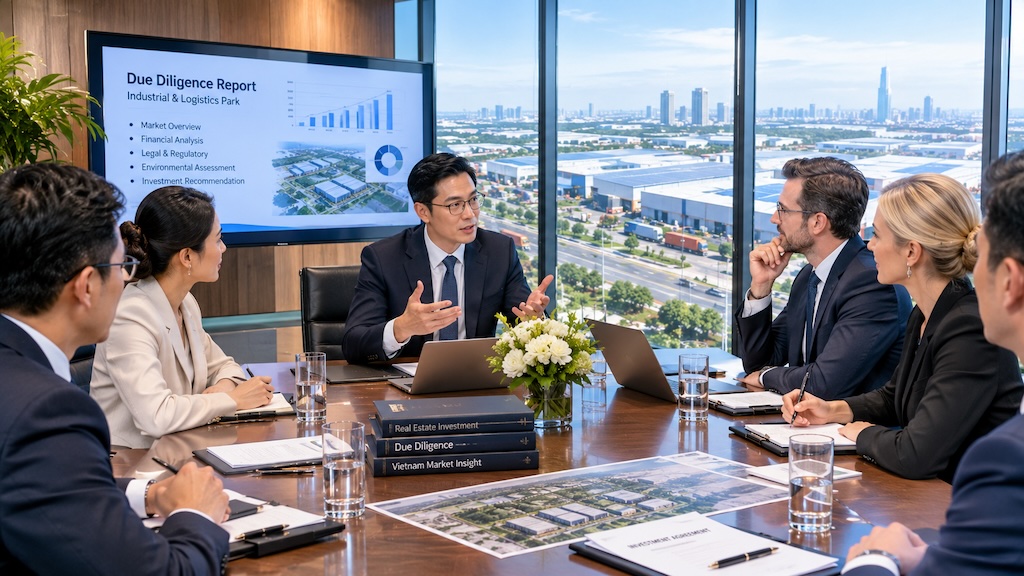
Negotiating M&A deals in logistics real estate to catch the new FDI wave in the HCMC logistics market.
Frequently Asked Questions (FAQ) about the Logistics Market
Below are the 6 most practical questions that investors and Supply Chain Managers frequently ask when working with the N.N GROUP ecosystem while learning about the HCMC logistics market and automated storage solutions:
1. What is the current rental price for Class A smart warehousing in neighboring areas?
In strategic suburban areas (Binh Duong, Dong Nai, Long An), asking rents for Class A automated facilities range from 4.5 USD to 6.0 USD/m2/month (excluding VAT and management fees). For cold storage or specialized temperature-controlled warehouses, the price can be double, from 10 USD to 15 USD/m2/month due to expensive operational costs (Opex).
2. Are 100% foreign-owned FDI enterprises allowed to self-build and operate warehouses for subleasing?
Absolutely allowed. Vietnamese law allows FDI enterprises to operate in the real estate business sector, including building facilities for lease or providing goods storage logistics services. However, businesses must ensure they register the correct related VSIC industry codes when applying for the Investment Registration Certificate (IRC).
3. What is the biggest difference between a Ready-built Warehouse and a Built-to-Suit warehouse?
Ready-built warehouses have mass designs serving general storage needs and customers can move in immediately. Conversely, Built-to-Suit warehouses are custom-designed and built exactly to the specific technical standards of a new FDI wave (special floor loads, massive electrical systems). This model requires a long construction time (12-18 months) and a very long-term lease commitment (over 10 years).
4. How can I quickly assess the capacity of a premise to establish smart warehousing?
To deploy Automated Storage and Retrieval Systems (AS/RS), 3 vital factors to evaluate immediately are: (1) Minimum clear ceiling height of 10m; (2) Foundation quality and concrete floor surface flatness (must meet F-min standards for robots to move); and (3) Power supply transformer station capacity. Not every old warehouse can be renovated into an automated hub.
5. How do the latest Fire Safety regulations affect logistics warehouse development?
From 2024, Fire Safety regulations (especially QCVN 06:2022/BXD) have significantly raised requirements for the fire resistance limits of materials (partitions, fire doors), escape routes, and the maximum allowable fire compartment area. Many automated projects are delayed in appraisal progress because the initial design failed to adapt promptly to this regulation change.
6. What is the best solution to avoid legal risks when acquiring (M&A) an operating logistics project?
The biggest risk in M&A usually lies in land legal records (unfulfilled financial obligations), environmental licenses, and tax debts. The only and safest solution is to hire a professional unit like N.N SERVICE to conduct a comprehensive Legal & Financial Due Diligence before signing any binding Term Sheet.
Conclusion: Strategic positioning with the N.N GROUP ecosystem
The transformation of the HCMC logistics market under the impact of modern storage demand and the rise of the new FDI wave is a clear testament to the competitive capacity and resilience of the Vietnamese economy. In the next decade, logistics is not just a supporting service industry, but the “circulatory system” determining the development pace of all high-tech industrial and e-commerce value chains.
To master this fierce game, investors and multinational corporations need a sharp vision, rapid decision-making ability, and a partner network capable of solving complex problems from physical space to legal barriers. The N.N GROUP ecosystem proudly offers a closed “All-in-One” solution suite, accompanying businesses to optimize the supply chain right from the starting line:
- Initialize spatial advantages with N.N REALTY: Exploit off-market data on strategic industrial land funds and Grade A+ smart warehousing projects along the Ring Road 3 planning and satellite areas. Our team of experts will represent the business to set up the commercial negotiation table (Leasing & M&A), ensuring optimal costs and perfect technical advantages for the project.
- Protect legality and cash flow with N.N SERVICE: We act as legal “strategists”, completely untangling administrative knots regarding the Investment Certificate (IRC), Environmental License (EIA), and Fire Safety (PCCC). Concurrently, the financial team will perform in-depth Due Diligence for all acquisition deals, ensuring the business’s new FDI wave lands in the Vietnamese market safely and with absolute transparency in the HCMC logistics market.
Don’t let logistics infrastructure shortages bottleneck your revenue stream and your organization’s global development vision. Let the N.N GROUP ecosystem become your guiding compass, maximizing the protection of your investment assets and creating a smart, sustainable supply chain for your business today!