

FDI Guide: Commercial Real Estate Ownership & Leasing 2026
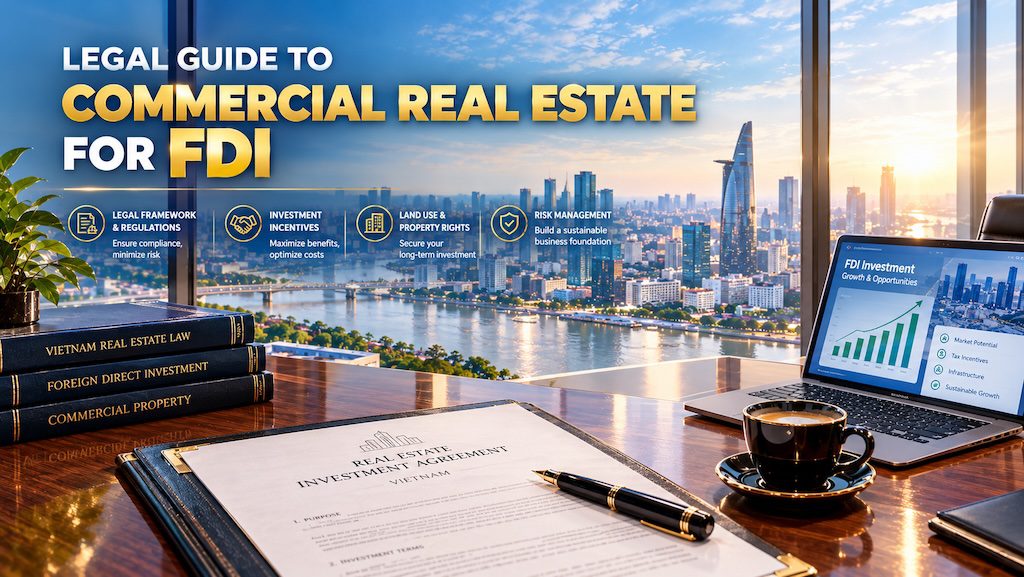
Entering a new development cycle, Vietnam continues to assert its position as a strategic destination for foreign direct investment (FDI) flows. Along with the shift of global supply chains, the demand for establishing headquarters, representative offices, and manufacturing facilities in major economic centers, especially Ho Chi Minh City (HCMC), is booming.
However, real estate is always a sensitive field with complex legal constraints. Mastering the regulations on commercial real estate ownership and leasing commercial property is a vital problem for all FDI enterprises before making capital injection decisions.
The real estate market in HCMC is witnessing a scarcity of Grade A office supply in the central area (District 1) and the strong rise of the new administrative-financial center in Thu Thiem.
This change in economic geography comes with continuous updates to the legal system. A deep understanding of FDI real estate regulations under the latest Land Law, the new real estate business law, and the Housing Law has opened up many opportunities, but simultaneously tightened conditions to ensure transparent market development.
This in-depth article is designed as a comprehensive legal handbook, providing foreign investors with the clearest picture of the limits and rights when leasing commercial property. We will analyze in detail legal transaction forms, and especially potential legal risks that FDI businesses must absolutely avoid when wanting to invest in physical space in the center of HCMC.
Macro expert’s perspective: Vietnamese law has clear limits on land use rights for foreign entities. Correctly understanding the nature of “land lease rights” instead of “permanent ownership” is the foundation for FDI enterprises to build financial strategies and depreciate assets accurately when proceeding with commercial real estate ownership in Vietnam.
Legal context: The new Land Law and new real estate business law
The perfection of the legal system is a positive signal for the investment environment. When evaluating FDI real estate regulations, the amended Land Law and Real Estate Business Law have brought clearer definitions and expanded access to physical space for foreign entities. Investors need to grasp the following core spirits to ensure legal safety.
First, the constitutional principle: Land belongs to the entire people with the State acting as the representative manager. Therefore, FDI enterprises do not have the right to “own land”, but are only granted “Land use rights”. The concept of “ownership” in the regulations on commercial real estate ownership only applies to assets attached to the land (such as construction works, office buildings, factories).
Second, for foreign direct investment (FDI) enterprises, the rules on leasing commercial property have a clear distinction based on the form of receiving land use rights. FDI enterprises can receive them through State allocation (with land use levy collection), subleasing, or through receiving investment capital transfer which is the value of land use rights, creating a legal premise for commercial real estate ownership.
In HCMC, where the land fund in central districts has been exhausted, multinational corporations mainly apply FDI real estate regulations through long-term contracts in existing office buildings, or signing at the Saigon Hi-Tech Park (SHTP) in Thu Duc City to build their own infrastructure serving their business and production processes.
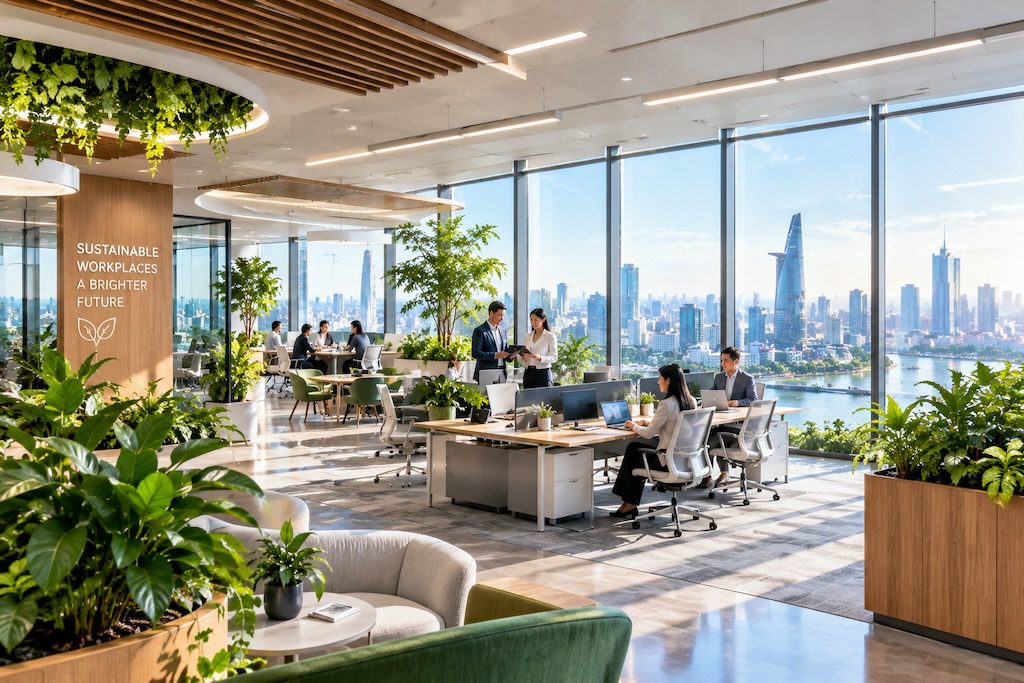
Grade A office space in Thu Thiem is always the top priority for multinational corporations.
Regulations on commercial real estate ownership for FDI enterprises
Unlike apartments, which have a 30% foreign ownership limit, the legal mechanism for property ownership and leasing for FDI enterprises opens up more flexible corridors but also requires more complex project structures. Knowing the boundaries of authority when establishing assets is extremely important.
FDI enterprises have the right to own constructions (office buildings, commercial service areas) that they invest in building on the land area allocated or leased by the Vietnamese State. This right is protected by law and recorded on the Pink Book, proving the legality of leasing commercial property.
However, within the framework of FDI real estate regulations, FDI enterprises ARE NOT ALLOWED to buy a ready-built office building from other individuals or organizations with the sole purpose of retaining it as an accumulated asset. Buying and transferring a project for business purposes must go hand in hand with implementing activities strictly according to the originally approved goals.
To better understand the forms and corresponding authorities when FDI enterprises proceed to establish assets, refer to the detailed legal structure analysis table below:
| Form of accessing Real Estate | Authorities & Legal Limits |
|---|---|
| Leasing land directly from the State (One-off payment) | Construction assets are recognized. Have the right to transfer, lend, or mortgage with land use rights to strengthen financial capacity at credit institutions. |
| Leasing land directly from the State (Annual payment) | Assets on land are recognized. Only allowed to mortgage assets attached to the land (not allowed to mortgage land use rights under the framework of these property regulations). |
| Receiving transfer of the entire project | Inherit the rights of the old investor. Must meet financial capacity conditions to maintain the legality of the entire investment process. |
| Buying existing commercial assets | Only allowed to buy for use as a headquarters to serve project goals; this is a key point in the law (cannot be bought for pure real estate business). |
Therefore, for corporations wanting to establish headquarters in HCMC, applying for an in-principle policy for land allocation to self-build, or utilizing the new real estate business law to cooperate on entire Grade A offices in Thu Thiem Urban Area for a long term are the safest strategies.
Regulations on leasing commercial property: Terms and conditions
In reality, the form of space utilization (Leasing) accounts for a larger proportion. Over 90% of FDI enterprises apply the legal framework on leasing commercial property to locate offices and shopping centers when expanding business in HCMC. This mechanism creates a very open corridor for long-term cooperation activities.
FDI enterprises have the right to establish spaces from project investors (domestic or foreign) or from legal business organizations. As a general rule, the term is agreed upon by the parties, but cannot exceed the project’s land allocation term (usually a maximum of 50 years). Extending the term is a major plus point of the FDI real estate regulations policy.
When negotiating contracts and flexibly applying the law in central areas of HCMC, investors need to pay special attention to complex legal clauses to optimize property acquisitions:
| Negotiation Items | Potential risks during the transaction process | Legal recommendations |
|---|---|---|
| Legality of assets | The building has not been approved for Fire Prevention and Fighting (PCCC), violating legality, making the business unable to apply for an Enterprise Registration Certificate (ERC). | Request the full provision of the PCCC Acceptance Record and Pink Book to confirm legal space usage rights. |
| Discounts and inflation | Sudden cost fluctuations after 2-3 years, breaking established financial plans. | Fix the cap rate in long-term contracts (usually no more than 5-7%/year). |
| Right to use vacant space (Sub-leasing) | Forbidden to sublease vacant area to a third party, going against the flexible benefits of the leasing mechanism. | Include a clause allowing partial re-exploitation of the premises in the original document to optimize privileges. |
The involvement of a professional brokerage organization like N.N REALTY is essential. We provide the ceiling/floor prices of Grade A offices in District 1 or Thu Thiem, assisting businesses in reviewing project risks to ensure smooth investment activities.
Risk management warning: A common mistake when applying the new real estate business law is signing a Memorandum of Understanding (MOU) and placing a large deposit before checking PCCC documents. Inability to apply for a business license due to safety rule violations will lead to severe damages.
“Shadowing” legal risks and the problem of asset transparency
An alarming hidden corner when mentioning the aspect of physical space is the situation of circumventing the law. Due to restrictions on transfer conditions, a portion of foreign entities have used the form of “asking a Vietnamese person to stand in name” to acquire prime locations, in order to control the process of property ownership and leasing in HCMC.
This form is carried out through authorization contracts; however, from the perspective of Civil Law, this circumvention transaction harbors extremely terrible risks.
According to the law, “fake” agreements to conceal true ownership will be declared void. When a dispute occurs (the nominee refuses to return the asset), foreign investors risk losing everything because the validity is not recognized by law. Cash flows through unofficial channels violating the FDI real estate regulations mechanism will face difficulties when transferring profits back home.
Asset transparency is the ultimate standard. FDI enterprises must strictly comply with predetermined standards. Instead of taking the “beaten path”, investors should use a safe legal structure (M&A of the project-owning enterprise) under the guidance of experts who understand the regulations on commercial property laws.
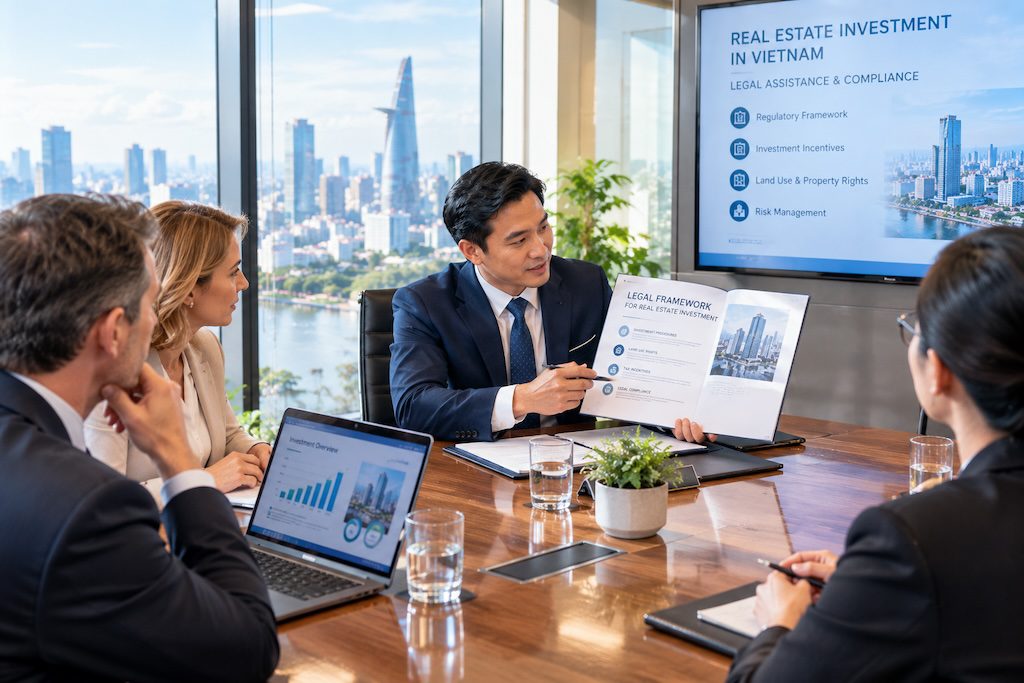
In-depth legal consulting helps FDI enterprises eliminate risks when transacting commercial real estate.
Investment procedures and licensing processes related to Real Estate
Once a premise meeting the exact criteria has been located, the next step is executing administrative tasks. Depending on the applied form within the property ownership and leasing framework, the process will differ:
| Transaction Form | Key execution steps to legalize the space | Receiving Agency |
|---|---|---|
| Long-term office use (Leasing) | Sign agreement ➔ Use contract to prove location for IRC and ERC applications, establishing business status. | HCMC Department of Planning and Investment. |
| Receiving project transfer (M&A) | Legal due diligence ➔ Apply for name transfer decision ➔ Sign contract ➔ Issue Pink Book, completing the property transaction. | HCMC People’s Committee, Department of Natural Resources and Environment. |
| Exploiting land in Hi-Tech Park | Apply for in-principle approval ➔ Sign exploitation contract ➔ Issue IRC, ERC ➔ Apply for valid Construction Permit. | Hi-Tech Park Management Board (SHTP). |
This process requires an understanding of the actual operational regulations of departments and agencies. Support from N.N SERVICE’s investment consulting services will help businesses untangle legal knots around leasing commercial property, minimizing waiting times.
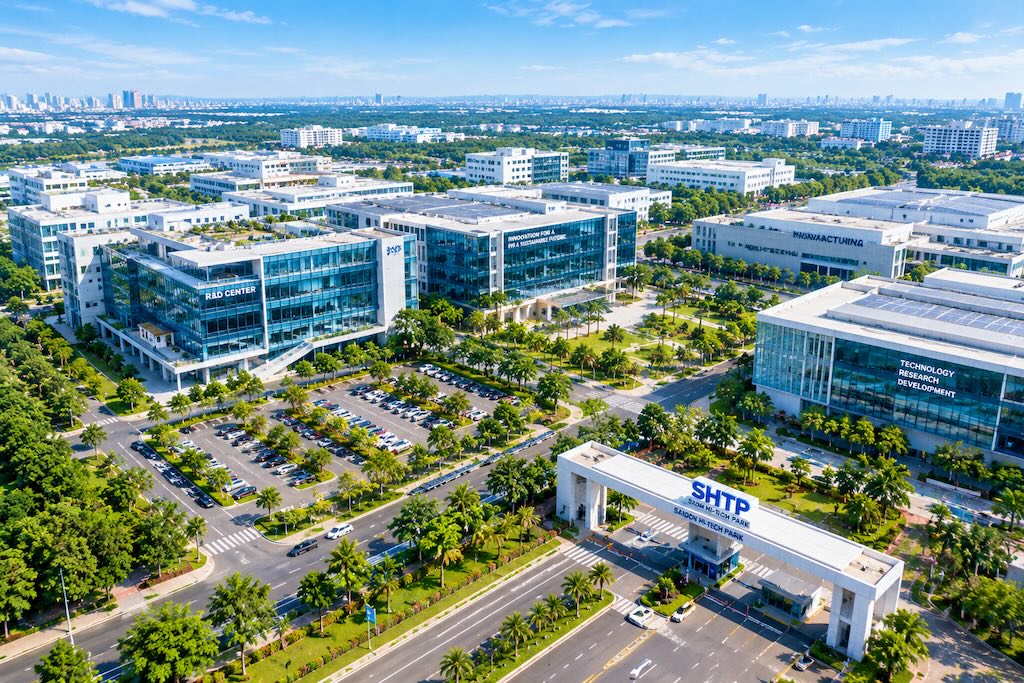
Commercial complex and industrial factory projects in HCMC must strictly comply with the new real estate business law.
Frequently Asked Questions (FAQ)
Below are the 6 most practical questions related to establishing physical space that foreign investors frequently ask when working with the N.N GROUP ecosystem:
1. Based on current law, can FDI buy offices permanently?
No. Vietnam’s FDI real estate regulations do not recognize permanent Freehold rights for foreign organizations. FDI enterprises are only recognized for construction works for a specific term (maximum 50 years).
2. Can I use an apartment as a company headquarters according to general regulations?
Absolutely not. According to commercial property standards, apartments are strictly for residential purposes. You cannot use an apartment address to register a headquarters on the Enterprise Registration Certificate (ERC), except for valid Officetel units.
3. Are contracts over 10 years legally required to be notarized?
The new law stipulates that if the contract is signed with an investor having a real estate business function, it is NOT mandatory to notarize. But if signed with an individual, notarization is necessary to protect legality when conducting property transactions.
4. Can FDI sub-lease premises based on ownership privileges?
Allowed. However, to comply with new real estate business law provisions, the business must register the corresponding business line code (VSIC 6810) and must obtain the property owner’s written consent before subleasing.
5. When the 50-year period expires, how are construction assets handled?
According to the management mechanism, businesses can apply for an extension. If not extended, the State will recover that space. Compensation (if any) is implemented according to the prevailing real estate laws at that time.
6. How can I check the building’s legality (PCCC) before executing the contract?
To ensure compliance with transparency, you need to request the provision of the Pink Book, Construction Permit, and PCCC Acceptance Record. It is best to have a legal expert appraise them to avoid risks when proceeding with real estate transactions.
Conclusion: Safe investment, sustainable development with N.N GROUP
Understanding and strictly complying with statutory principles is the core foundation for multinational corporations and FDI enterprises to establish a solid, safe operational base in the HCMC megacity. Acumen in applying these regulations is the key to increasing competitive capacity.
To completely eliminate “shadowing” risks, optimize agreement structures, and locate Grade A spaces that meet legal property standards, the companionship of an “All-in-One” B2B consulting ecosystem like N.N GROUP is a prerequisite:
- Through N.N REALTY, we provide transparent data, directly represent you in searching for Grade A (ESG) offices in District 1, Thu Thiem, or land funds at SHTP, ensuring transactions perfectly meet legal requirements.
- Synchronizing with N.N SERVICE, our team of legal experts will conduct in-depth appraisal of documents, assist in finalizing the tightest agreements, and help your business launch projects with absolute peace of mind.
Don’t let potential legal risks in contracts slow down your development progress. Let the N.N GROUP ecosystem become your strategic partner, creating business spaces that fully meet FDI real estate regulations today!