

AI Data Centers in Ho Chi Minh City: The New Investment Wave and Infrastructure Challenges in 2027
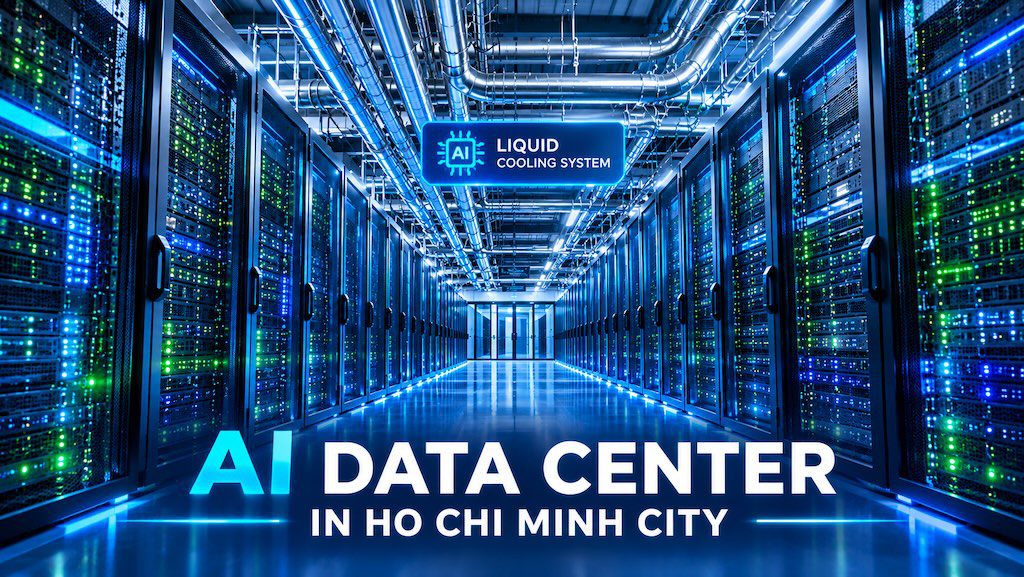
The Vietnamese industrial real estate map is witnessing a structural shift. FDI capital flows are no longer purely focused on manufacturing factories, but are shifting strongly towards technology infrastructure assets. Most prominent in this trend is the formation of AI data centers in HCMC.
Not merely traditional server storage facilities, the new generation of data centers is specifically designed to serve the massive computing capacity of Artificial Intelligence (AI) and Machine Learning.
This is an ambitious new investment wave, attracting the attention of global technology giants (Hyperscalers) like Google, Microsoft, Amazon, as well as international infrastructure investment funds.
For the real estate market, the boom of AI data centers in HCMC not only establishes a new value level for high-tech industrial land but also creates a massive added value chain for mechanical and electrical (MEP) contractors, energy suppliers, and operation management units.
However, behind the attractiveness of this new investment wave is a harsh reality. The rapid development of AI technology is placing unprecedented pressure on the power grid system, cooling systems, and urban planning, shaping an extremely complex 2027 infrastructure problem.
This in-depth analysis report will dissect the core drivers fueling the new investment wave, identify bottlenecks in the 2027 infrastructure problem, and provide a strategic perspective helping B2B investors and foreign funds optimize capital injection decisions into the technology infrastructure real estate segment at the Southern economic locomotive.
Macro analysis perspective: Entering the 2026-2027 cycle, AI data centers in HCMC no longer compete by geographical location, but by the ability to access “power and cooling”. An AI server consumes 4 to 5 times more power than a standard cloud computing server.
Therefore, the 2027 infrastructure problem is essentially a problem of committing to continuous green power supply (Renewable Energy) and Liquid Cooling technology. High-tech industrial parks (like SHTP) if they do not upgrade their power grid infrastructure early will quickly lose their advantage in this new investment wave to neighboring countries like Malaysia or Indonesia.
Core drivers of the AI data center investment wave
The rise of AI data centers in HCMC is not a random phenomenon, but the result of the convergence of global computing demand and Vietnam’s macroeconomic policies. This new investment wave is driven by three core drivers.
First, the Cybersecurity Law and Data Localization requirements. Increasingly tightening legal regulations force cross-border technology platforms (Social Networks, E-commerce, OTT) to store user data in Vietnam. This creates a massive and stable “demand” for server space, ensuring high occupancy rates as soon as AI data centers in HCMC go into operation.
Second, the digital transformation aspiration of the domestic corporate sector. From commercial banks, retail corporations to large healthcare systems, applying AI to analyze Big Data and automate processes requires extremely low latency.
AI algorithm processing servers must be placed as close to the end-user (Edge Computing) as possible, making HCMC a golden coordinate for infrastructure deployment.
Third, the diversification of the technology supply chain. US-China geopolitical tensions have caused global corporations to adopt the “China Plus One” strategy.
Vietnam, with its strategic location in the center of Southeast Asia, and a long coastline favorable for international submarine optical cables to land, is becoming an ideal Data Hub in the new investment wave. B2B businesses wanting to catch foreign capital flows can regularly follow tech FDI capital flow analysis reports from N.N GROUP to determine the right time and area to invest capital.
The Global AI Arms Race and Vietnam’s Positioning
The exponential growth of Generative AI models (like ChatGPT and its successors) has triggered a global arms race for computing power.
Hyperscalers are scrambling to secure infrastructure globally to train and deploy these massive language models. Vietnam, and specifically Ho Chi Minh City, finds itself in a unique geopolitical and economic sweet spot.
While traditionally trailing hubs like Singapore or Hong Kong, land scarcity, exorbitant power costs, and strict moratoriums on new Data Center constructions in those mature markets are forcing tech giants to seek viable alternatives.
HCMC, offering competitive land prices, a young, increasingly skilled engineering workforce, and a government actively pivoting towards a digital economy, presents a compelling value proposition.
This new investment wave is therefore not just a domestic real estate play, but a strategic repositioning of Vietnam within the global tech infrastructure supply chain.
Anatomy of the 2027 infrastructure problem: Power and Cooling
The attractiveness of the new investment wave is undeniable, but the biggest barrier preventing billion-dollar capital flows into AI data centers in HCMC lies in technical factors. The 2027 infrastructure problem revolves around two vital challenges: Energy and Heat Dissipation.
Unlike traditional Data Centers with a power consumption density of 5-10 kW/rack, AI servers using super chips (like NVIDIA H100, B200) require a power density up to 40-100 kW/rack.
This means a medium-sized AI data centers in HCMC (about 30-50 MW) will consume power equivalent to a residential area of tens of thousands of households.
The existing power grid system in traditional industrial parks is not designed for massive concentrated loads operating 24/7 at maximum capacity. The 2027 infrastructure problem requires Industrial Developers to build specialized transformer stations and establish independent transmission lines.
More importantly, under the pressure of ESG (Environmental – Social – Governance) commitments, global tech corporations demand the power supply to be green power (wind power, solar power).
The Direct Power Purchase Agreement (DPPA) mechanism recently passed is an important legal step forward, but widespread practical implementation still requires determination from the city government.
The second challenge is heat dissipation technology. With the massive thermal energy emitted from AI super chips, traditional Air Cooling systems have become powerless.
To solve the 2027 infrastructure problem, these advanced facilities are forced to switch to Liquid Cooling or Immersion Cooling technologies.
This technology requires a complex piping system, an extremely large floor load-bearing structure, and an internationally qualified MEP engineering team – a resource still scarce in Vietnam.
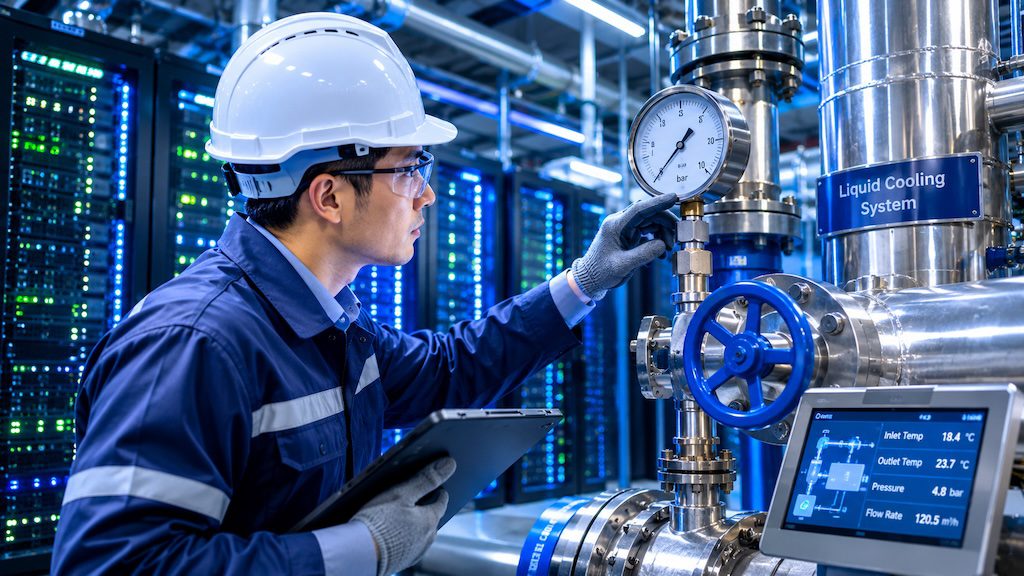
AI servers using super chips consume massive amounts of energy, requiring complex Liquid Cooling systems to maintain 24/7 operating performance.
Navigating the Human Capital Bottleneck
While physical infrastructure and power supply dominate the conversation, the silent bottleneck threatening the rapid expansion of these advanced facilities is human capital.
Designing, building, and operating these highly complex, liquid-cooled facilities requires a specialized workforce that is currently in short supply locally.
Expertise in advanced MEP engineering, HVAC optimization for high-density racks, and cybersecurity architecture is paramount.
To mitigate this risk, foreign investors are increasingly partnering with local universities and vocational schools, essentially ‘insourcing’ their talent pipeline.
Furthermore, this skills gap presents a lucrative secondary new investment wave for B2B training providers and specialized recruitment agencies.
Institutional investors must factor the availability and cost of this highly specialized talent into their operational expenditure (Opex) models during the due diligence phase, as talent scarcity will inevitably drive up operational costs and potentially delay facility commissioning.
Opportunities to revalue high-tech industrial real estate
The strictness of the 2027 infrastructure problem unintentionally creates a solid “economic moat” for B2B investors who understand the market.
Normal industrial land plots cannot easily convert their functions into these advanced facilities. The scarcity of qualified space supply is pushing colocation rental prices and high-tech land fund transfer prices to record levels.
Two areas directly benefiting from this new investment wave are the Saigon Hi-Tech Park (SHTP – East Pole) and Quang Trung Software City (QTSC). SHTP possesses an absolute advantage regarding the presence of international optical cable stations and priority power grids.
However, the clean land fund here is exhausted. This forces the new investment wave to spill over to satellite areas like Tan Phu Trung Industrial Park (Cu Chi) or Hiep Phuoc Industrial Park (Nha Be), where there is still room to establish large-capacity transformer stations.
| Core Technical & Infrastructure Factors | Mandatory standards for AI Data Centers | Economic Impact & B2B M&A Opportunities |
|---|---|---|
| Power supply capacity & Renewable Energy | Required capacity > 30MW. Must have a Renewable Energy Certificate (REC) mechanism or Direct Power Purchase Agreement (DPPA) to meet international ESG standards. | Industrial parks owning separate 110kV transformer stations will have soaring M&A valuations. Opportunities for Rooftop Solar developers. |
| Fiber optic Latency & International Connectivity | Direct connection to Landing stations of submarine optical cable routes (AAG, APG, AAE-1). Massive bandwidth serving AI server connections. | Land funds in Thu Duc City and District 7 possess existing telecommunications infrastructure advantages, attracting Hyperscalers to acquire “Brownfield” land funds. |
| Structural load & Liquid Cooling | Extremely large floor load (> 15-20 kN/m2) to bear the weight of coolant tanks and heavy-duty backup generators continuously 24/7. | Eliminates renovation projects from old factories (due to not meeting loads). Lucrative bidding opportunities for international MEP general contractors and load-bearing material suppliers. |
| Physical security certificate & Urban planning | Meeting Uptime Tier III / Tier IV standards. Not located in flood-prone depressions, not under direct flight paths, solid multi-layer security boundaries. | Strict requirements on Risk-free zone planning. Investors need to carefully appraise the ground elevation (Topography) before pouring capital to solve the 2027 infrastructure problem. |
For digital infrastructure investment funds, searching for land funds satisfying all 4 factors above is like “panning for gold in the sand”. Consulting from units understanding local planning is mandatory.
Businesses can look up industrial real estate project data from N.N REALTY to quickly locate clean land funds, perfectly meeting the strict criteria to build AI data centers in HCMC. Please refer to the document named “CODE WEB” for more insights on integrating digital property management platforms.
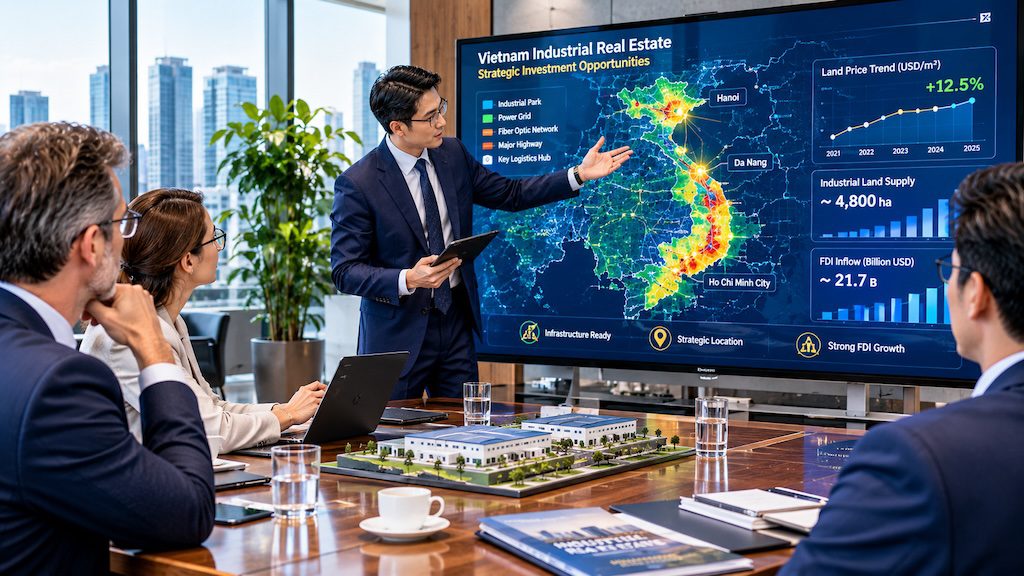
The scarcity of land funds meeting strict standards on transformer stations and optical cable connections is pushing the value of high-tech industrial parks to record levels.
Legal Due Diligence and Data Center investment risks
In the new investment wave, acquiring land funds or M&A of Data Center project shares always comes with specific legal barriers, completely different from residential real estate.
Decoding the 2027 infrastructure problem lies not only in technology, but also in complying with Vietnamese laws on investment and cyberspace.
First, according to the amended Telecommunications Law effective from 2024, data center services are classified as basic telecommunications services (but subject to a lighter management mechanism).
Foreign investors are allowed to own 100% foreign capital (not subject to foreign room limits like before), however, the process of applying for the Investment Registration Certificate (IRC) and Power Purchase Agreement (PPA) with EVN requires an extremely detailed explanation dossier on security technology, fire prevention and fighting, and Environmental Impact Assessment (EIA).
Second, architectural design and the placement of backup diesel generator blocks (Gensets) or fuel tanks are always the biggest barriers in the PCCC appraisal process according to QCVN 06:2022/BXD.
Delays in licensing can stall the entire business plan, pushing the project into the risk of capital overrun. To ensure a smooth development process, the appraisal of M&A dossiers and 1/500 scale planning needs to be entrusted to the infrastructure legal consulting team of N.N SERVICE.
They will play the role of establishing a safety corridor, protecting the hundreds of millions of USD capital flows of institutional investors.

The process of acquiring land funds (M&A) to develop AI data centers requires strict legal appraisal operations regarding energy certificates, fire safety, and planning.
The art of architectural feng shui in technology infrastructure
An interesting point little known when investing in these advanced facilities is the similarity between the strict requirements of server systems and feng shui principles. In feng shui, Data Center buildings have a very prosperous “Fire” property (due to the heat continuously emitted by machinery 24/7). If there is no balance from the “Water” element (Liquid Cooling systems, landscape lakes) and “Metal” (MEP systems, solid security), the project easily encounters technical incidents or operational stagnation.
Arranging heat dissipation airflows and the direction of the Network Operations Center (NOC) not only complies with aerodynamics but also ensures the circulation of “Life Force”, bringing stability to data flows. Architects of modern industrial works often consult architectural feng shui design principles from N.N REALTY to choose locations for servers and transformer stations, thereby optimizing functionality and increasing sustainable business prosperity for high-tech assets.
Frequently Asked Questions (FAQ) about AI Data Centers
Below are the 6 most highly practical questions that financial institutions and industrial developers frequently raise when analyzing the new investment wave into these advanced facilities and identifying the 2027 infrastructure problem:
1. How is an AI data center different from a traditional cloud computing Data Center (DC)?
2. According to the new Telecommunications Law (2024), are foreign investors restricted from owning shares in Data Center projects in Vietnam?
3. What is the most difficult 2027 infrastructure problem when developing an AI Data Center in HCMC?
4. Which areas in HCMC are prioritized for building Data Center infrastructure?
5. How can a foreign investment fund successfully acquire (M&A) a developing Data Center project (Brownfield) in HCMC?
6. How does the passage of the Direct Power Purchase Agreement (DPPA) mechanism affect these projects?
Conclusion
The formation of these advanced facilities marks a turning point in Vietnam’s digital economic structure. This new investment wave not only solves urgent computing needs but also establishes a new standard level for the industrial real estate segment.
However, thoroughly solving the 2027 infrastructure problem regarding power, heat dissipation technology, and environmental legalities is a prerequisite to retaining billion-dollar foreign capital flows. Technology-savvy B2B investors who master the rules of the game will reap outstanding return rates from this critical infrastructure asset class.
In a market where high-tech real estate transactions (Data Centers, Smart Logistics) require a deep intersection between technical knowledge and sharp legal thinking, the N.N GROUP ecosystem provides a specialized investment solution suite:
- Through in-depth data from N.N REALTY, we support investment funds in positioning clean industrial land funds (Brownfield & Greenfield) perfectly meeting the criteria of power load supply, spatial planning for these advanced facilities, representing acquisition negotiations at the most optimal prices.
- Accompanying N.N SERVICE, the Legal Due Diligence process for international M&A contracts, procedures to apply for the Investment Registration Certificate (IRC) and DPPA agreements will be handled confidentially and professionally, absolutely protecting the legitimate interests of financial institutions.
Don’t let technical and legal barriers hinder your organization’s technology asset acquisition plans. Let the N.N GROUP ecosystem become the strategic compass, guiding businesses to successfully plant their flag in the AI infrastructure new investment wave today!