

Ho Chi Minh City to Implement 87 Flood Mitigation Projects by 2030: Which Areas Are Being Prioritized?
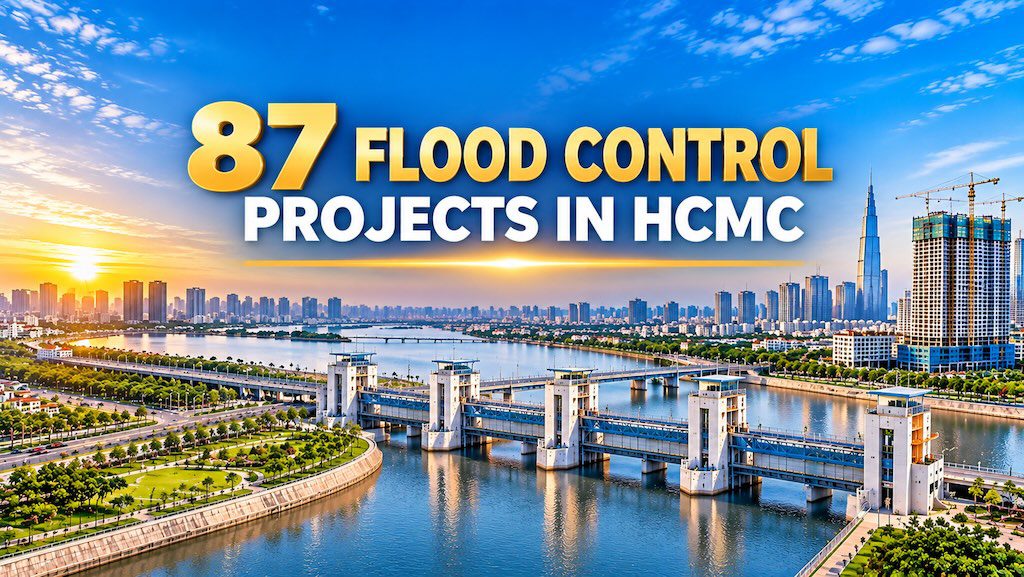
Ho Chi Minh City, the economic locomotive of the country, is facing a vital urban challenge: climate change and widespread flooding. The combination of high tides, extreme rainfall, and rapid concretization has turned the drainage issue into the biggest bottleneck hindering the development of the real estate ecosystem and logistics supply chains.
To completely solve this problem, the city government has activated a super investment strategy with 87 key HCMC anti-flooding projects, having a total investment of up to tens of trillions of VND, spanning from now to 2030.
For commercial real estate investors, foreign funds, and multinational corporations, the implementation roadmap of these anti-flooding projects is not just dry infrastructure information. It is a map pointing to cash flows.
Completely solving the flooding situation in an area will immediately establish a new price level for real estate there, while simultaneously unblocking strategic locations to establish general distribution warehouses or high-end retail spaces.
Conversely, pouring capital into low-lying areas, which are not prioritized in the planning, will be a gamble containing countless financial risks.
This in-depth article is designed as a macroeconomic lens, providing Chief Strategy Officers, Chief Investment Officers (CIOs), and C-levels with a panoramic view of the strategy for anti-flooding projects.
We will detail the portfolio of prioritized disbursement projects, analyze their direct impact on the urban structure, and outline how businesses can leverage the planning to increase the value of commercial and service supply chains.
Drainage infrastructure planning expert’s perspective: The difference of the 2026 – 2030 period compared to the previous decade is the strategic shift from “local anti-flooding” to “inter-regional flood control”.
The focus of the 87 HCMC anti-flooding projects is not just laying more box culverts, but the integration of large-scale tide control sluices (like the 10,000 billion VND mega-project) and the dredging of natural canals.
Businesses need to pay special attention to the progress of embankment works within these anti-flooding projects, as they will reshape the entire face of real estate along the Saigon River.
Panoramic picture: Portfolio of 87 strategic HCMC anti-flooding projects
Based on the Anti-flooding and Wastewater Treatment Project for the 2020-2045 period along with the 2026-2030 mid-term plan, the capital structure to implement drainage infrastructure planning in HCMC is divided into multiple different spearheads. Out of a total of 87 HCMC anti-flooding projects, the city is concentrating efforts on 35 projects using direct budget capital and 52 projects calling for public-private partnerships (PPP) or international ODA capital.
Grasping which are the core works in the list ofanti-flooding projects will help institutional investors accurately forecast the shifting direction of the residential and commercial real estate markets.
| Classification of HCMC anti-flooding projects | Typical work items & Disbursement priorities | Impact on Real Estate / Logistics Market |
|---|---|---|
| HCMC anti-flooding projects due to High Tides | Mega-project to combat tidal flooding considering climate change factors (Phase 1) with 6 large tide control sluices (Ben Nghe, Tan Thuan, Phu Xuan, Muong Chuoi, Cay Kho, Phu Dinh). | Rescuing the entire area of District 7, Nha Be, District 4, and part of District 8. Activating a new price level for Grade A office spaces and high-end serviced apartments along the river. |
| HCMC anti-flooding projects due to Inner-city Rain | Upgrading and renovating the sewer system according to the planning orientation on streets frequently suffering severe flooding (Nguyen Huu Canh, Vo Van Ngan, Le Duc Tho, Pham Van Chieu streets). | Increasing stability for high-end retail spaces and ensuring last-mile delivery supply chains are not disrupted during the rainy season. |
| Dredging main drainage axes & Natural canals | Focusing capital on HCMC anti-flooding projects dredging and environmentally improving Xuyen Tam canal (extending through Go Vap, Binh Thanh) and renovating Tham Luong – Ben Cat – Nuoc Len canals. | Turning low-lying areas along canals into model ecological urban areas (Eco-cities). Bringing opportunities to execute extremely valuable waterfront real estate M&A deals. |
| Pumping Station System & Wastewater Treatment Plants | Building Binh Hung wastewater treatment station (expansion), Nhieu Loc – Thi Nghe wastewater treatment plant, meeting international ESG standards on the urban environment according to planning. | Enhancing the sustainability of regional infrastructure, attracting Green Funds to pour capital into surrounding commercial real estate projects. |
Closely monitoring the disbursement progress table of the works belonging to these HCMC anti-flooding projects is the wisest move. Through periodic reports from N.N GROUP, investors can anticipate real estate price increase cycles, especially in areas transforming thanks to anti-flooding projects.
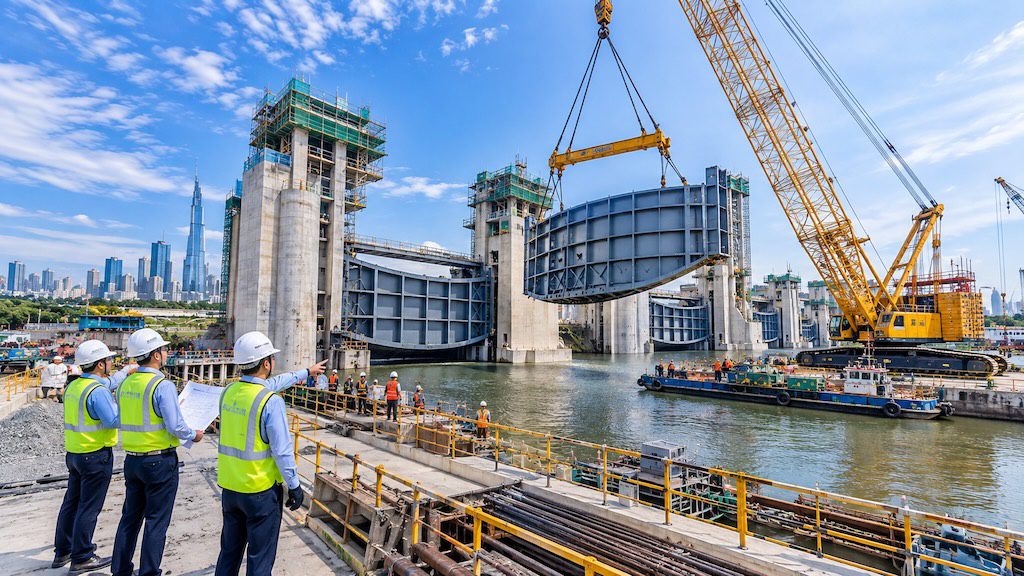
The tide control sluice mega-project is the “savior” protecting urban and commercial spaces in the South Saigon area.
Disbursement priority: Savior of the South and East Zones
With limited budget resources, not all 87 HCMC anti-flooding projects are deployed simultaneously. The city government is applying a strategy of “Key investment, definitive resolution”, prioritizing absolutely the two areas most heavily affected but carrying the highest strategic economic value: The South Zone (District 7, Nha Be) and the East Zone (Thu Duc City).
In the South Zone, the nearly 10,000 billion VND mega anti-flooding projects dealing with high tides are the biggest lifesaver. The District 7 area (especially the Huynh Tan Phat, Tran Xuan Soan axes) was originally a black spot for tidal flooding, causing severe damage to logistics warehousing infrastructure at Tan Thuan Port and neighboring export processing zones.
When the 6 large tide control sluices go into operation, this will be the greatest achievement of drainage infrastructure planning. The entire urban ecosystem in South Saigon will escape the scenario of “living with floods”. This is an extremely positive signal for multinational corporations wanting to establish modern warehouses in this area without fearing flooding risks from incompleteanti-flooding projects.
For the East Zone (Thu Duc City), positioned as a high-tech nucleus and financial center (Thu Thiem), the problem solved by the 87 anti-flooding projects focuses on handling rainwater and locally low-lying terrain.
Prioritizing planning on axes like Vo Van Ngan, Nguyen Duy Trinh, and National Route 50 not only protects high-end residential areas but also ensures smooth connections with key industrial parks (SHTP).
Commercial space development businesses can consult the floor elevation design standards from N.N REALTY to ensure Grade A office buildings are always absolutely safe in climate change scenarios that HCMC anti-flooding projects have not yet fully covered.
Direct impact on supply chains and warehousing (Logistics)
The flooding situation is not just a commuting issue, it is the “number one enemy” of the logistics industry and the Supply Chain.
Warehoused goods getting moldy, delivery trucks stalling on deeply flooded roads, and goods unable to board ships on schedule are financial losses that no FDI enterprise wants to bear in the absence of synchronized drainage infrastructure planning.
The synchronized deployment of the 87 HCMC anti-flooding projects will completely remove these bottlenecks, creating a safe operating environment and optimizing costs (Opex) for businesses.
Specifically, the axes connecting Cat Lai, Tan Thuan, and Hiep Phuoc ports will be guaranteed 24/7 circulation regardless of the weather thanks to anti-flooding projects.
Furthermore, the completion of planning also opens up opportunities to restructure the Warehousing network.
Previously, due to fear of flooding, many businesses had to accept pushing Distribution Centers far out of the inner city.
When the flooding situation is controlled by HCMC anti-flooding projects, Retailers and E-commerce corporations can completely confidently acquire large logistics premises right within the inner city to establish extremely modern automated order processing centers.
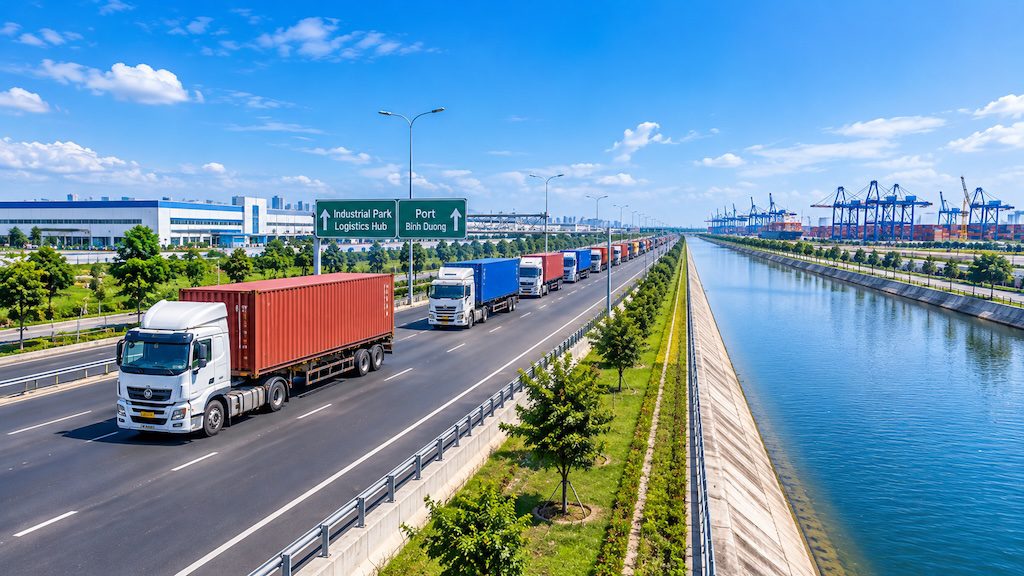
Eliminating the risk of flooding helps trucking flows connect directly to urban centers safely 24/7.
B2B Investment Opportunities: Infrastructure and Environmental Real Estate (ESG)
From the perspective of institutional investors, the execution strategy of the 87 HCMC anti-flooding projects is not just about the state spending money, but a gold mine for M&A deals and public-private partnership (PPP) projects. Especially, in the context where Environmental – Social – Governance (ESG) standards are becoming a compass for global capital flows, the development of drainage infrastructure planning in HCMC is attracting immense attention from green investment funds.
The most attractive B2B investment opportunities from the system of HCMC anti-flooding projects currently focus on the following fields:
- Waterfront Real Estate Development: Works belonging to the 87 anti-flooding projects such as renovating Xuyen Tam Canal, Tham Luong – Ben Cat Canal will clear canal-side slums, replacing them with concrete embankments and riverside parks. The clean land funds after clearance will be extremely valuable, opening up opportunities to build prime commercial spaces.
- Supplying wastewater treatment technology: Anyanti-flooding projects go hand in hand with upgrading wastewater treatment plants according to planning. Foreign businesses providing membrane bioreactor (MBR) technology, and large-capacity pumping station equipment will have the opportunity to bid for packages worth hundreds of millions of USD.
- Sponge City development: This is an advanced planning trend supporting the 87 anti-flooding projects being encouraged by HCMC. New urban area developers will enjoy many incentives if integrating rainwater collection and reuse systems into their projects. Businesses can leverage this planning advantage to increase brand value.
However, participating in anti-flooding projects or acquiring land funds in areas undergoing drainage infrastructure planning adjustments always harbors complex legal risks regarding site clearance compensation. Accompanying the legal expert team of N.N SERVICE will help businesses strictly appraise dossiers, completely eliminating the risks of buried capital.

Thoroughly appraising the planning boundaries of the safe corridor protecting rivers and canals is an indispensable step for hunting commercial land funds.
Frequently Asked Questions (FAQ) about anti-flooding planning
Below are the 6 most practical questions that real estate investors frequently ask when working with the N.N GROUP ecosystem during the process of assessing flooding risks and the potential of planning:
1. When is the 10,000 billion VND mega HCMC anti-flooding projects due to high tides expected to be completed and put into use?
After many delays due to capital entanglements, this core anti-flooding project has restarted and is being fiercely urged by the city government. Currently, this landmark work among the anti-flooding projects has completed over 95% of the volume, definitively solving flooding for the South Saigon area.
2. Is it safe to buy real estate in areas where the 87 HCMC anti-flooding projects are under construction?
Anticipating drainage infrastructure planning always yields extremely high return rates. HCMC anti-flooding projects often require road excavations in the short term. However, for a long-term investment vision (3-5 years), this is a golden opportunity to buy in at a good price before the system is completed from the anti-flooding projects and property prices soar.
3. Is the Thu Thiem New Urban Area in a flood risk zone when drainage infrastructure planning is incomplete?
Thu Thiem was systematically planned from the beginning with a very high construction elevation and a modern, independent sewer system as part of its planning. Therefore, this area is almost immune to tidal flooding, not depending too much on the overall progress of citywide anti-flooding projects.
4. How to check if an intended leased/purchased land plot is in the beneficiary zone of HCMC anti-flooding projects?
Besides field surveys, investors should request a check of the floor elevation map and cross-check with the Department of Construction’s planning map. Using consulting services from N.N REALTY experts will provide you with the most accurate reports on the land plot’s infrastructure status compared to the project network.
5. Are FDI enterprises allowed to participate in investing in the city’s HCMC anti-flooding projects?
Yes. Ho Chi Minh City highly welcomes and is calling for international investment funds to participate in the portfolio of 87 HCMC anti-flooding projects through public-private partnerships (PPP), especially for items related to drainage infrastructure planning requiring high technology.
6. How will the execution of the Tham Luong – Ben Cat Canal drainage infrastructure planning affect real estate values?
These anti-flooding projects are an infrastructure “miracle”, running through 7 districts. The completion of the embankment system of the 87 anti-flooding projects here will turn the Northwest area into bustling urban areas, strongly stimulating the development of commercial apartment projects and riverside retail spaces.
Conclusion: Holding a pioneering position with the N.N GROUP ecosystem
The journey to actualize the 87 HCMC anti-flooding projects is not just an effort to cope with climate change, but a revolutionary urban reconstruction endeavor.
The success of this drainage infrastructure planning strategy will completely remove the tight shirt, opening up unlimited development space for the commercial real estate ecosystem, logistics supply chains, and strongly attracting FDI resources through large-scale anti-flooding projects.
For institutional investors, accurately positioning the direction of budget capital flows into core projects from the portfolio of anti-flooding projects is the key to creating an exclusive competitive advantage.
The N.N GROUP ecosystem proudly brings a comprehensive “All-in-One” B2B solution suite, accompanying you on every step of development, maximizing the value of planning:
- Initialize spatial advantages with N.N REALTY: Our team of brokerage experts will represent the business to locate and acquire the most prime commercial spaces and land funds—where they directly benefit from anti-flooding projects before price levels soar.
- Protect legality and finance with N.N SERVICE: Our senior lawyer team will perform in-depth Due Diligence regarding land origins and planning boundaries. Ensuring that investment cash flows into the beneficiary zones of anti-flooding projects are always safely protected.
Don’t let flooding risks and information opacity hinder your organization’s expansion strategy. Let the N.N GROUP ecosystem become the guiding compass, maximizing the protection of investment assets and leveraging advantages from HCMC anti-flooding projects today!