


Explore the 30% PIT and CIT tax reduction for 2026–2027 under Decree 398 ?

The 30% PIT and CIT tax reduction for 2026–2027 provides targeted relief for eligible business taxpayers in Vietnam. It can improve cash flow, but eligibility depends on annual revenue, taxpayer status and the income concerned. A business with several locations cannot assess its entitlement by looking at just one outlet.
Decree 398/2026/ND-CP, effective from 29 October 2026, implements Resolution 43/2026/QH16. Its personal income tax (PIT) provisions cover business income of resident individuals. Its corporate income tax (CIT) provisions apply to eligible enterprises and other organizations established under Vietnamese law.
This guide explains the 30% PIT and CIT tax reduction, using practical calculations and filing considerations for taxpayers in Ho Chi Minh City. The key is to establish eligibility first, calculate the correct liability, and keep monitoring revenue throughout the year.
Policy scope: Relief applies to the 2026 and 2027 tax years, with each year assessed separately. The annual revenue ceiling is VND 10 billion, inclusive. The 30% PIT and CIT tax reduction does not extend to employment income or automatically reduce value added tax (VAT).
What does the 30% PIT and CIT tax reduction actually mean?
The policy reduces eligible tax payable by 30%. It does not reduce taxable revenue by 30%, introduce a flat 30% tax rate, or cut an existing tax rate by 30 percentage points. Tax must first be calculated under the relevant rules before the reduction is applied.
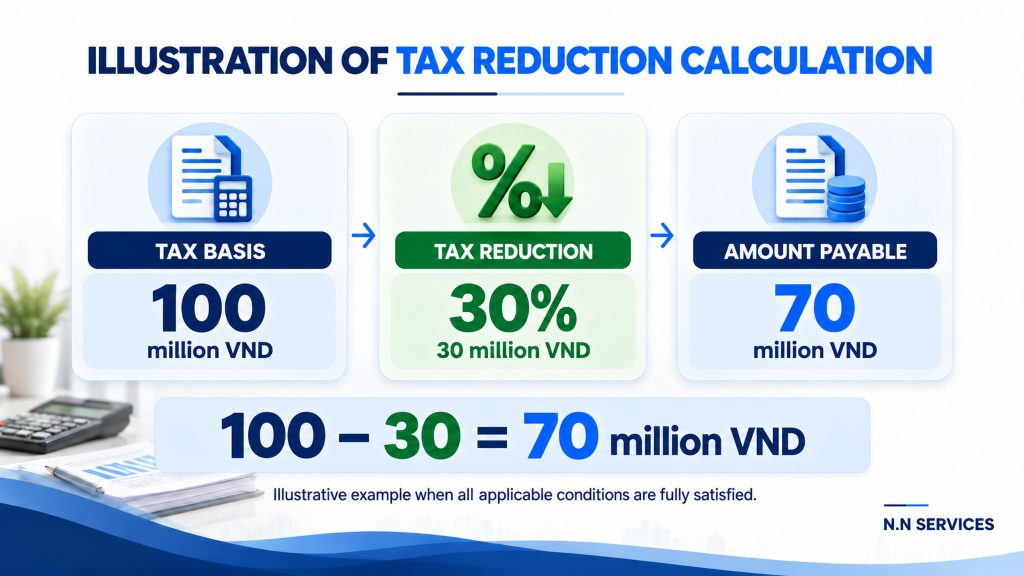
For example, an eligible tax liability of VND 100 million produces a reduction of VND 30 million, leaving VND 70 million payable. Applying 30% directly to business revenue would confuse the revenue eligibility test with the tax calculation.
The effective date also needs careful interpretation. Although Decree 398 took effect on 29 October 2026, the 30% PIT and CIT tax reduction concerns eligible liabilities for the 2026 and 2027 tax years. It is not limited to income earned after the effective date.
Who qualifies for relief?
Before applying the 30% PIT and CIT tax reduction, identify the taxpayer and classify the income. Having revenue below the ceiling is important, but it does not turn every type of personal income into eligible business income.
| Taxpayer category | Potentially eligible tax | Main eligibility check |
|---|---|---|
| Resident individuals carrying on business | PIT payable on business income for 2026 or 2027. | Aggregate annual business revenue must not exceed VND 10 billion. |
| Eligible enterprises and organizations | CIT payable for the relevant annual tax period. | Correct revenue aggregation and compliance with the specific exclusion for division or separation. |
| Employees receiving salaries | Employment income is outside this PIT relief. | Business revenue thresholds must not be applied to payroll income. |
| Taxpayers with no eligible tax liability | There is no corresponding tax amount to reduce. | The policy does not create a cash grant equal to 30% of revenue. |
The CIT category includes enterprises, cooperatives, cooperative unions, public service units and other organizations established under Vietnamese law that conduct business and earn income, subject to the applicable conditions. Eligibility is not restricted to privately owned domestic companies.
For individuals, tax residence must be distinguished from nationality. A person who earns both salary and business income must assess those income categories separately. The 30% PIT and CIT tax reduction cannot be applied to a combined total that includes employment tax.
Business income within the decree’s scope is considered regardless of the applicable tax calculation method. However, this does not remove the need to establish the correct underlying tax liability.

How should the VND 10 billion ceiling be calculated?
Aggregate all business activities of the individual
For the 30% PIT and CIT tax reduction, a resident individual’s revenue test covers all relevant business activities during the year. Different shops, sales channels or parties filing on the individual’s behalf do not each provide a separate VND 10 billion allowance.
Consider a business owner in Ho Chi Minh City with VND 6 billion in store revenue and VND 5 billion from online business during the same year. Aggregate business revenue is VND 11 billion. The individual fails the revenue test even though each channel separately remains below the ceiling.
Exactly VND 10 billion satisfies the “not exceeding” condition, provided all other requirements are met. Revenue must be determined under the applicable rules, rather than rounded down to preserve eligibility for the 30% PIT and CIT tax reduction.
Include the relevant enterprise revenue categories
For CIT, the revenue test includes sales and service revenue after revenue deductions, financial revenue, and other income included under the applicable rules. Reviewing only sales revenue on an internal management report can therefore produce the wrong conclusion.
Revenue of dependent units and business locations must also be included within the enterprise’s relevant reporting scope. Moving revenue between the head office and a dependent branch does not create another entitlement to the 30% PIT and CIT tax reduction.
For example, an enterprise records VND 9.6 billion in sales revenue after deductions, VND 250 million in financial revenue and VND 200 million in other income. If all these amounts fall within the required calculation, the total is VND 10.05 billion and exceeds the ceiling.
Assess each year separately: Eligibility in 2026 does not automatically carry over to 2027. The decree does not require revenue to have declined from the preceding year, and the prior year’s figures cannot replace the revenue test for the year being assessed.
How is the 30% PIT and CIT tax reduction calculated?
The arithmetic behind the 30% PIT and CIT tax reduction is straightforward. The difficult part is selecting the correct tax amount. For PIT, use eligible business income tax. For CIT, calculate the amount remaining after other applicable tax incentives before applying this reduction.
| Calculation stage | Method | Illustration |
|---|---|---|
| Eligible tax base for relief | Determine tax payable before the Decree 398 reduction, after any relevant prior incentives. | VND 100 million. |
| Reduction | Multiply the eligible tax amount by 30%. | VND 30 million. |
| Remaining liability | Subtract the reduction from the eligible tax amount. | VND 70 million before offsetting payments already made. |
Example for a resident individual carrying on business
Assume annual business revenue is VND 8 billion and correctly calculated PIT before this relief is VND 80 million. If all conditions are satisfied, the 30% PIT and CIT tax reduction provides PIT relief of VND 24 million. The remaining PIT liability is VND 56 million.
The VND 80 million figure is an illustration, not a standard tax amount or rate for every business sector. VAT, other obligations and payments already made must be tracked separately.
Example for an enterprise already receiving another incentive
Assume an eligible company’s revenue is VND 9 billion. CIT before other incentives is VND 200 million, and a valid existing incentive reduces that amount by VND 40 million. The amount used for the additional reduction is therefore VND 160 million.
The 30% PIT and CIT tax reduction produces a further CIT reduction of VND 48 million. Remaining CIT is VND 112 million before offsetting provisional payments. Applying 30% to the original VND 200 million would disregard the required calculation sequence.
The CIT scope includes income referred to in Article 18(3) of the Law on Corporate Income Tax, as provided by Decree 398. Do not automatically exclude all enterprise real estate income by importing restrictions from a different tax incentive regime.
How do individual businesses claim the reduction?
The 30% PIT and CIT tax reduction operates through the applicable tax calculation and filing process. The practical task is to prepare reliable revenue data and use the correct accompanying form, rather than assume a separate approval certificate is required.
| Form | Relevant situation | Submission context |
|---|---|---|
| Form No. 01 | A resident individual carrying on business expects annual revenue not to exceed VND 10 billion. | Accompanies the applicable quarterly, first-half, second-half or annual return. |
| Form No. 02 | An organization or individual withholds, files or pays PIT on behalf of a business individual, based on revenue within its remit. | Accompanies the relevant monthly, quarterly or transaction-based PIT return. |
| Form No. 03 | Actual aggregate annual business revenue exceeds VND 10 billion and previous relief must be reversed. | Accompanies the return for the period in which cumulative revenue exceeds the ceiling. |
For the 30% PIT and CIT tax reduction, use the forms issued with Decree 398, rather than unrelated tax forms bearing similar numbers. Their availability does not allow taxpayers to select a filing frequency inconsistent with their actual obligations.
A withholding or filing party assesses the VND 10 billion condition using revenue within its own withholding, filing or payment remit. The individual remains responsible for combining all business activities when checking the final entitlement to the 30% PIT and CIT tax reduction.
For assistance reconciling revenue across channels, explore N.N SERVICES household business tax services. The objective is to establish a consistent calculation supported by the underlying records.
How should enterprises handle provisional CIT payments?
An enterprise expecting annual revenue not to exceed VND 10 billion may determine the 30% PIT and CIT tax reduction when calculating quarterly provisional CIT payments. This is not a new requirement to submit quarterly CIT returns.
Maintain a cumulative revenue schedule covering sales, financial revenue, other income and dependent units. Review unusual or substantial receipts before the next payment, rather than relying on an estimate prepared at the start of the year.
If actual revenue exceeds the ceiling, the enterprise must reassess its entitlement to the 30% PIT and CIT tax reduction, recalculate its liability and pay the shortfall. Late-payment interest follows Article 24(3) of Decree 252/2026/ND-CP. The special treatment for individual businesses must not be transferred to corporate taxpayers.
The four quarterly provisional payments must also be checked against the requirement to reach at least 80% of the self-declared annual CIT liability. Review the 30% PIT and CIT tax reduction alongside annual tax finalization, including incentives and payments already made.
What happens if revenue later exceeds VND 10 billion?
For an individual business, actual annual revenue above the ceiling requires reversal of all relief previously claimed for that year. The correction is not limited to the excess revenue or to the quarter in which the ceiling was crossed.
Suppose the individual previously claimed VND 18 million through the 30% PIT and CIT tax reduction. Once cumulative annual business revenue exceeds VND 10 billion, that entire VND 18 million must be paid back using the prescribed reporting process.
The individual-specific protection against late-payment interest runs only until the filing deadline for the period in which cumulative revenue exceeds the ceiling. It is not an indefinite waiver, and delaying payment beyond that point can have consequences under tax administration rules.
Monitoring the 30% PIT and CIT tax reduction during the year is therefore essential. A year-end review alone may identify the problem after the relevant filing deadline has passed.
What if tax was already declared or paid?
Eligible taxpayers who filed without claiming the 30% PIT and CIT tax reduction should review the relevant adjustment, supplementary filing or annual finalization route. Payment before 29 October 2026 does not, by itself, prevent correction of an eligible 2026 liability.
For individual businesses taxed using a revenue-based percentage method, an overpayment determined for the year may be credited, refunded, or refunded together with an offset, as applicable. Entitlement to relief does not guarantee an immediate cash refund.
If a competent authority increases the assessed tax liability, the additional eligible amount can still benefit from the 30% PIT and CIT tax reduction when the taxpayer continues to qualify. If the underlying liability decreases, the reduction must also be recalculated accordingly.
Penalties and late-payment interest are separate obligations. Taxpayers must not reduce these amounts by 30% simply because the underlying tax qualifies for relief.
Special situations requiring closer review
Enterprise division or separation
A specific exclusion concerns enterprises formed through division or separation after Resolution 43 took effect on 24 August 2026, where the combined revenue of all resulting enterprises exceeds VND 10 billion. Looking only at each resulting enterprise separately can misstate eligibility for the 30% PIT and CIT tax reduction.
This rule should not be generalized into automatic aggregation of every company under common ownership. Keep the restructuring documents, relevant dates and the required revenue reconciliation.
Combined first or final tax periods
Where a first or final period shorter than three months is combined with the relevant 2026 or 2027 annual tax period, the decree specifies the relevant 12-month scope for revenue and relief calculations.
That limited rule does not mean every short operating period must automatically be annualized. Assess the 30% PIT and CIT tax reduction against the actual tax-period arrangement and separate any combined-period figures correctly.
Differentiate individual property income from enterprise income
An individual’s property-transfer PIT does not automatically become eligible business income tax. Enterprise CIT must be assessed under its own provisions, including the income scope expressly addressed by Decree 398.
When reviewing property projects through N.N REALTY, establish the taxpayer, ownership structure and transaction obligations before forecasting tax savings. The 30% PIT and CIT tax reduction does not replace transaction-specific legal and tax review.

A practical checklist for taxpayers in Ho Chi Minh City
The 30% PIT and CIT tax reduction is a national policy. Taxpayers in Ho Chi Minh City work with their managing tax authority through the appropriate filing channels; there is no separate local entitlement to obtain.
For the 30% PIT and CIT tax reduction, prepare a working file that connects the figures in the return to the underlying business records:
- Annual revenue schedules by activity, location and sales channel.
- Invoice reconciliations, revenue deductions, financial revenue and other relevant income.
- Calculations showing the original tax, existing incentives and proposed reduction.
- Returns, accompanying forms, payment records and information from parties filing on behalf of the taxpayer.
- Restructuring documents or combined-period calculations where relevant.
This checklist supports review and explanation; it does not mean every document must accompany every submission. Further business guidance is available through the N.N SERVICES knowledge hub and N.N GROUP news.
Frequently asked questions about the 30% PIT and CIT tax reduction
Conclusion
The 30% PIT and CIT tax reduction can support cash flow in 2026–2027 when eligibility and calculations are properly established. The essential work is to aggregate revenue correctly, distinguish income categories, apply incentives in the correct order, and respond promptly when actual figures change.
Within the N.N GROUP ecosystem, N.N SERVICES supports accounting, tax filing and business compliance, while N.N REALTY provides property information and solutions. Connecting tax obligations with operating plans and asset decisions helps businesses in Ho Chi Minh City make informed choices.
Need help checking eligibility and calculating your tax relief?
N.N SERVICES can assist with revenue reconciliation, liability review and preparation of filings suited to your actual circumstances.